
Aquatic Plant
Red Mangrove
Rhizophora mangleRhizophoraceaeMangroves
Price: $49.35 USD
Add from My tanks →1 photos
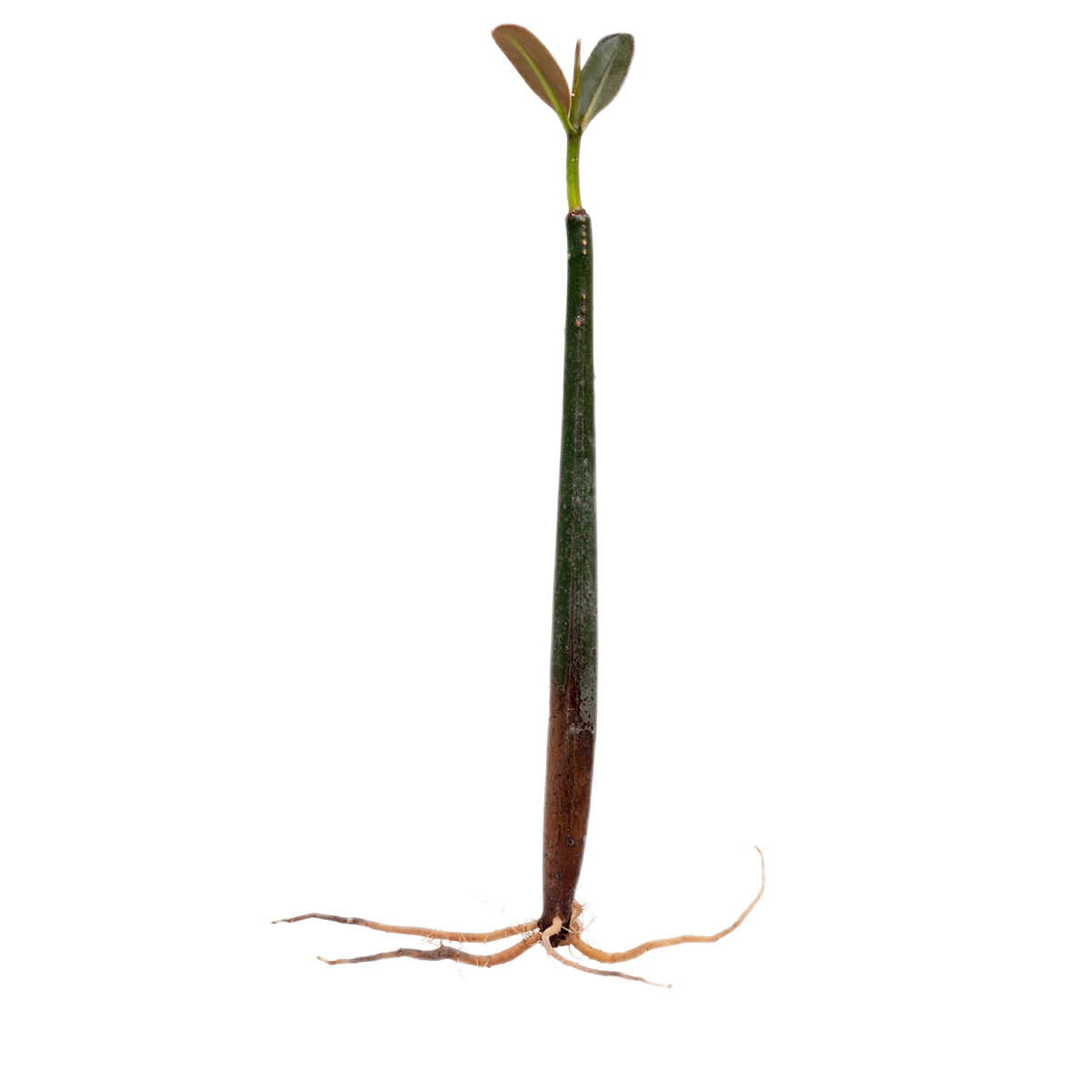
Red Mangrove (Rhizophora mangle) is a hardy, completely reef-safe plant for reef aquariums and refugiums that naturally absorbs nitrates, phosphates, and excess nutrients while adding a tropical aesthetic. Propagules vary from greenish to brownish depending on growth stage; thrives at 78-83°F, 8-12 dKH, pH 7.0-8.4, specific gravity 1.000-1.024, with trace element replenishment encouraging faster growth.
Quick facts
Identity
- Also known as
- American mangrove; Caribbean red mangrove
- Synonyms
- Rhizophora americana
- Environment
- Freshwater
- Native to
- Florida, Caribbean, Gulf of Mexico, Central America, northern South America, West Africa
- Habitat
- Tropical and subtropical intertidal shorelines, estuaries, and lagoons, rooting in soft tidal mud where fresh and salt water mix
- Sourcing
- Aquacultured
- Conservation
- Least Concern
Care
- Care level
- Moderate
- Growth form
- Upright
- Max height
- 6 – 48 in (15 – 122 cm)
- Spread
- 16 in (41 cm)
- Growth rate
- Slow
- Placement
- Background
Water
- Temperature
- 72 – 83 °F (22 – 28 °C)
- pH
- 7.0 – 8.4
- dKH
- 8 – 12 dKH
- Flow
- Low-Moderate
- Light
- High
- CO₂
- Not needed
Planting
- Substrate
- Nutrient-rich preferred
- Feeds from
- Roots
- Fertilizer needs
- High
- Colors
- Green
Feeding & breeding
- Propagation
- Plantlets
Something wrong or missing? Submit a correction
Care guide
Overview
Suited to reef systems and refugiums where a keeper wants a living nutrient export tool rather than a submerged plant, since the tree grows its leaves in open air above the waterline. The pencil-shaped propagule is rooted point-down in substrate or a pot, and its roots draw down nitrate and phosphate as they establish. Expect slow but steady growth under strong overhead light and periodic rinsing of salt crust from the foliage.
Care
This is a true woody tree rather than a typical aquatic plant, kept in the hobby by rooting its floating propagules in substrate while the stem and leaves grow up into open air. It needs strong overhead lighting focused on the emersed foliage, since the leaves are photosynthesizing outside the water, and an open-top tank, sump, or paludarium with plenty of vertical clearance. Growth is slow but the plant is otherwise tough, tolerating a wide swing of salinity from fresh to full seawater once acclimated gradually. The root system is extensive and can eventually stress glass or acrylic seams, so many keepers confine it to a removable pot.
Planting & trimming
Plant the pencil-shaped propagule point-down with the root end wedged in substrate or rockwork, leaving the growing tip and leaves above the waterline so they develop in open air. A deep bed of fine sand or mud rich in nutrients suits the roots best, though the plant can also be grown hydroponically with roots simply suspended in water. Because roots expand aggressively over years, use a large, removable pot to make future relocation easier and to protect the tank seams.
Fertilizing
Most nutrient uptake happens through the roots, so a nutrient-rich, muddy or sandy substrate matters more than dosing the water column, and root tabs or a mineralized substrate speed establishment. Supplemental iron and magnesium help prevent the leaf yellowing that shows up under deficiency, and refugium or reef tank nutrient loads (nitrate and phosphate) are readily absorbed by the roots as free fertilizer. Growth is slow enough that heavy fertilizing is rarely required once the plant is established.
Propagation
Propagation is via the viviparous, cigar-shaped propagules the tree drops, which are already partially developed seedlings that root readily when planted point-down in substrate. New plants are not grown from true seed or cuttings in the hobby; simply obtaining and planting fresh propagules is the standard method. Growth afterward is slow, so scaling up a display with home-grown propagules takes patience.
Problems
The most common issue is salt buildup on the emersed leaves, which forms a visible crust and should be rinsed off with fresh water every few days to keep the foliage healthy. Magnesium or iron shortfalls typically show up as yellowing leaves rather than outright melt. Dropped leaves should be removed promptly before they decompose and foul the water, and the plant responds poorly to heavy pruning so trimming should be limited to pinching new growth.
Sources
Varieties in the catalog
Something wrong or missing? Submit a correction
In the community
Popular tanks using Red Mangrove
No public tanks are showcasing Red Mangrove yet.