
Marine Invertebrates
Porcelain Anemone Crab
Neopetrolisthes maculatusPorcellanidaeAnemone Crabs
Price: $42.30 USD
Add from My tanks →1 photos
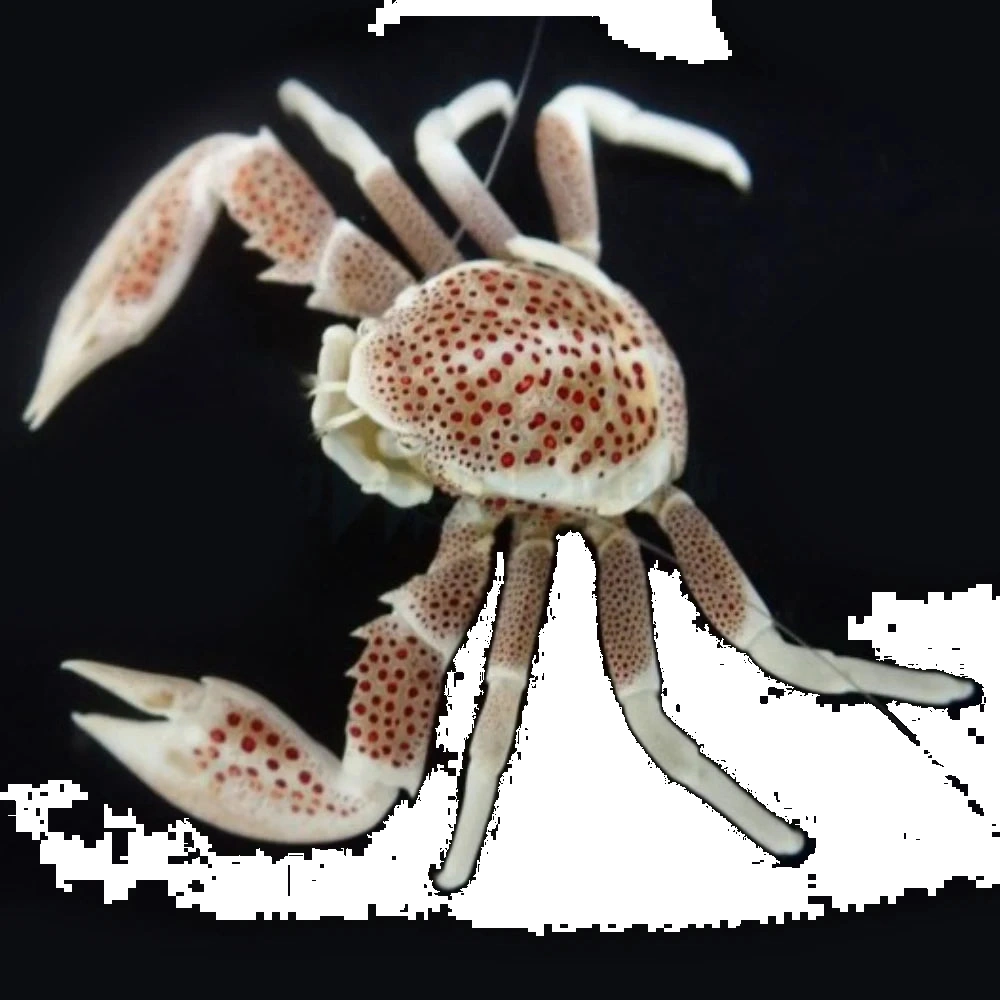
The Porcelain Anemone Crab is a beautiful, peaceful, reef-safe invertebrate known for its delicate appearance and unique feeding behavior — filtering food particles from the water with fan-like front claws to capture plankton and suspended foods. In the wild it lives in close association with sea anemones for shelter and protection; it needs a stable mature reef aquarium with moderate water flow to carry food particles and clean, stable water conditions, an anemone host is optional but beneficial, and supplemental feeding may be needed in low-nutrient systems.
Quick facts
Handling caution: None; large claws are for defense only and it is not venomous.
Identity
- Also known as
- Porcelain Crab; Anemone Crab
- Synonyms
- Neopetrolisthes ohshimai (often sold interchangeably)
- Environment
- Saltwater
- Native to
- Indo-Pacific, East Africa, Indian Ocean, Japan, Australia
- Habitat
- Shallow tropical coral reefs, living in obligate association with large sea anemones at depths of roughly 3 to 20 meters.
- Sourcing
- Wild-caught
- Conservation
- Not Evaluated
Care
- Care level
- Easy
- Temperament
- Peaceful
- Adult size
- 0.5 – 3 in (1.3 – 7.6 cm)
- Lifespan
- 2 – 4 yrs
- Min tank
- 10 gal (38 L)
- Growth rate
- Slow
- Placement
- Rock & glass
Water
- Temperature
- 72 – 79 °F (22 – 26 °C)
- pH
- 8.1 – 8.4
- dKH
- 8 – 12 dKH
- Salinity
- 1.023 – 1.026 SG
- Flow
- Moderate
Behavior & compatibility
- Social
- Pair · groups of 2+
- Aggression to own kind
- High
- Active
- Daytime
- Reef safe
- Yes
- Invert safe
- Yes
- Shrimp safe
- With caution
- Clean-up role
- Detritus
- Population boom risk
- Low
Feeding & breeding
- Diet
- Planktivore
- Foods
- Zooplankton, Phytoplankton, Frozen, Live, Micro-pellets
- Breeding type
- Broadcast spawner
- Breeding difficulty
- Not bred in captivity
- Sexing
- Not externally distinguishable by casual observation; females are typically seen carrying orange egg masses under the abdominal flap when berried.
- Target feeding
- Required
Something wrong or missing? Submit a correction
Care guide
Overview
Filters the water with two feathery fan-like claws, sweeping plankton and fine particles toward its mouth while perched motionless atop a host anemone. Cream-and-orange mottled and rarely more than a couple of inches across, it depends on stinging tentacles for defense rather than fighting. Best suited to a mature, low-flow-tolerant reef with stable chemistry and regular target feeding.
Care
This crab spends nearly its entire life perched on a host anemone, relying on the stinging tentacles for protection rather than defending itself. A mature reef tank with stable, pristine water quality and gentle to moderate flow to deliver food particles suits it best. Copper-based medications must never be used since they are lethal to all crustaceans, and sudden salinity swings during water changes should be avoided.
Feeding
In the wild and in well-stocked reef systems it filters passing plankton and fine particulate matter from the water using its two feathery fan appendages. Home aquariums rarely produce enough drifting food on their own, so regular target feeding of phytoplankton, zooplankton, or fine frozen and powdered foods released near the fans is usually necessary. It will also pick up mucus and leftover food from around its host anemone.
Tank mates
It is peaceful toward fish and corals but intolerant of other porcelain crabs of the same sex sharing its anemone, sometimes fighting to the death over territory. Clownfish that attempt to claim the same anemone are usually tolerated after a brief standoff, with the clownfish typically winning any dispute. Predatory fish known to eat crustaceans, such as wrasses, hawkfish, and puffers, should be avoided as tankmates.
Breeding
Females carry visible orange egg clutches beneath the abdomen before releasing planktonic larvae into the water column. These larvae almost never survive to settlement in a closed aquarium system due to the lack of appropriate plankton and current conditions. Because of this, the species is essentially never bred to maturity in home aquariums and stock is collected from the wild.
Health
Autotomy, the shedding of a claw or leg when stressed or grabbed, can occur but the limb is usually regenerated over subsequent molts. Molting failures linked to iodine or trace element deficiency are a recognized risk, so dosing iodine and trace elements in a reef system is worthwhile. Rapid shifts in salinity or temperature during water changes should be minimized since this crab is sensitive to abrupt parameter swings.
Sources
Something wrong or missing? Submit a correction
In the community
Popular tanks using Porcelain Anemone Crab
No public tanks are showcasing Porcelain Anemone Crab yet.