
Marine Invertebrates
Pom Pom Crab
Lybia tessellataXanthidaePom Pom Crabs
Price: $21.15 USD
Add from My tanks →1 photos
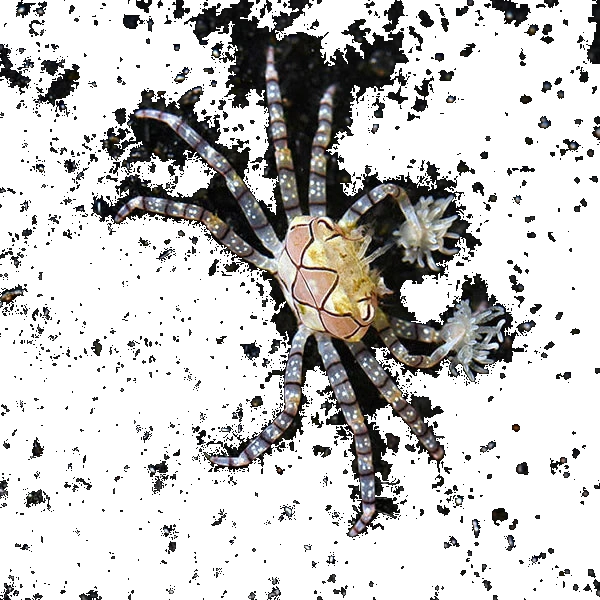
The Pom Pom Crab is white to tan with darker camouflage markings and carries a small anemone in each claw for defense and to mop up food from rocks and substrate. It helps clean leftover food and detritus, but use caution in reef aquariums since the anemones can sting sessile invertebrates and corals; feed meaty foods such as mysis shrimp, chopped fish, and clams.
Quick facts
Identity
- Also known as
- Boxer Crab; Cheerleader Crab
- Environment
- Saltwater
- Native to
- Red Sea, East Africa, Indo-Pacific, Indonesia, New Guinea, Japan, Hawaii
- Habitat
- Shallow reef flats and rubble zones, sandy or gravelly seabeds, and among live coral where it clings with its long legs
- Sourcing
- Wild-caught
- Conservation
- Not Evaluated
Care
- Care level
- Moderate
- Temperament
- Peaceful
- Adult size
- 0.5 – 1 in (1.3 – 2.5 cm)
- Lifespan
- 1 – 3 yrs
- Min tank
- 10 gal (38 L)
- Growth rate
- Slow
- Placement
- Bottom
Water
- Temperature
- 75 – 80 °F (24 – 27 °C)
- pH
- 8.1 – 8.4
- dKH
- 8 – 12 dKH
- Salinity
- 1.023 – 1.025 SG
- Flow
- Low-Moderate
Behavior & compatibility
- Social
- Solitary
- Aggression to own kind
- Moderate
- Active
- Night
- Reef safe
- With caution
- Invert safe
- With caution
- Shrimp safe
- With caution
- Clean-up role
- Detritus, Leftover food
- Population boom risk
- Low
Feeding & breeding
- Diet
- Omnivore
- Foods
- Frozen, Micro-pellets, Zooplankton
- Breeding type
- Larval (brackish)
- Breeding difficulty
- Not bred in captivity
- Sexing
- Females carry red eggs brooded on the underside of the abdomen; otherwise sexes look alike externally
- Target feeding
- Required
Something wrong or missing? Submit a correction
Care guide
Overview
Populations across the Red Sea, Indo-Pacific, and Hawaii supply the trade with this mottled white-to-tan xanthid, prized for the pair of anemones it waves in each claw. It stays tucked in rubble and rock crevices, emerging mainly to feed or defend territory. Small and easily outcompeted, it needs target feeding and a well-sealed, mature nano reef.
Care
This tiny xanthid crab spends most of its time tucked into crevices in live rock or rubble, emerging mainly to feed or defend its territory. It does best in a mature, well-established nano reef with plenty of small rock crevices and low to moderate flow so it can hold its anemones without being buffeted. Because it is so small and easily outcompeted, it should not be kept with fast, aggressive tankmates, and the tank must be well sealed since it can slip through very small gaps. Stable salinity, temperature, and pH are important, as this species does not tolerate rapid swings well.
Feeding
In the wild the crab cannot feed itself directly and instead uses the stinging tentacles of the small anemones in its claws to snag food particles, which it then transfers to its mouthparts. In captivity it should be target-fed several times a week with finely minced meaty foods such as mysis shrimp, chopped clam, or fish, released close to its hiding spot with a pipette or turkey baster. Without direct feeding it can be easily outcompeted by faster tankmates and slowly starve, so consistent supplemental feeding is important even in tanks with decent detritus levels.
Tank mates
Best paired with peaceful, non-predatory fish and invertebrates that will not view it as prey, such as small gobies, firefish, and snails. Avoid hawkfish, larger wrasses, triggers, puffers, lionfish, dottybacks, and large or aggressive shrimp such as coral banded shrimp, all of which may harass or eat it. The anemones it carries can sting sessile invertebrates and coral polyps if the crab wanders too close, so give it distance from delicate sessile life in the aquascape.
Breeding
Females brood red eggs on the underside of the abdomen after mating, and larvae are released into the water column as free-swimming zoea. Rearing the planktonic larval stages in a home aquarium is not practical and this species is essentially never bred in captivity by hobbyists. Any offspring seen in a reef tank are typically incidental and unlikely to survive to a visible size without dedicated larval culture.
Health
Most problems trace back to poor acclimation, sudden salinity or temperature swings, or exposure to copper-based medications, which are lethal to this and all crustaceans. A failed molt, indicated by lethargy, an inability to fully shed the old exoskeleton, or lost limbs, is often a sign of nutritional stress or unstable water parameters. Drip acclimation and a stable, mature system with consistent feeding help avoid these issues.
Sources
Something wrong or missing? Submit a correction
In the community
Popular tanks using Pom Pom Crab
No public tanks are showcasing Pom Pom Crab yet.