
Marine Invertebrates
ORA Tuxedo Urchin - Assorted Color
Mespilia globulusTemnopleuridaeUrchins
Add from My tanks →1 photos
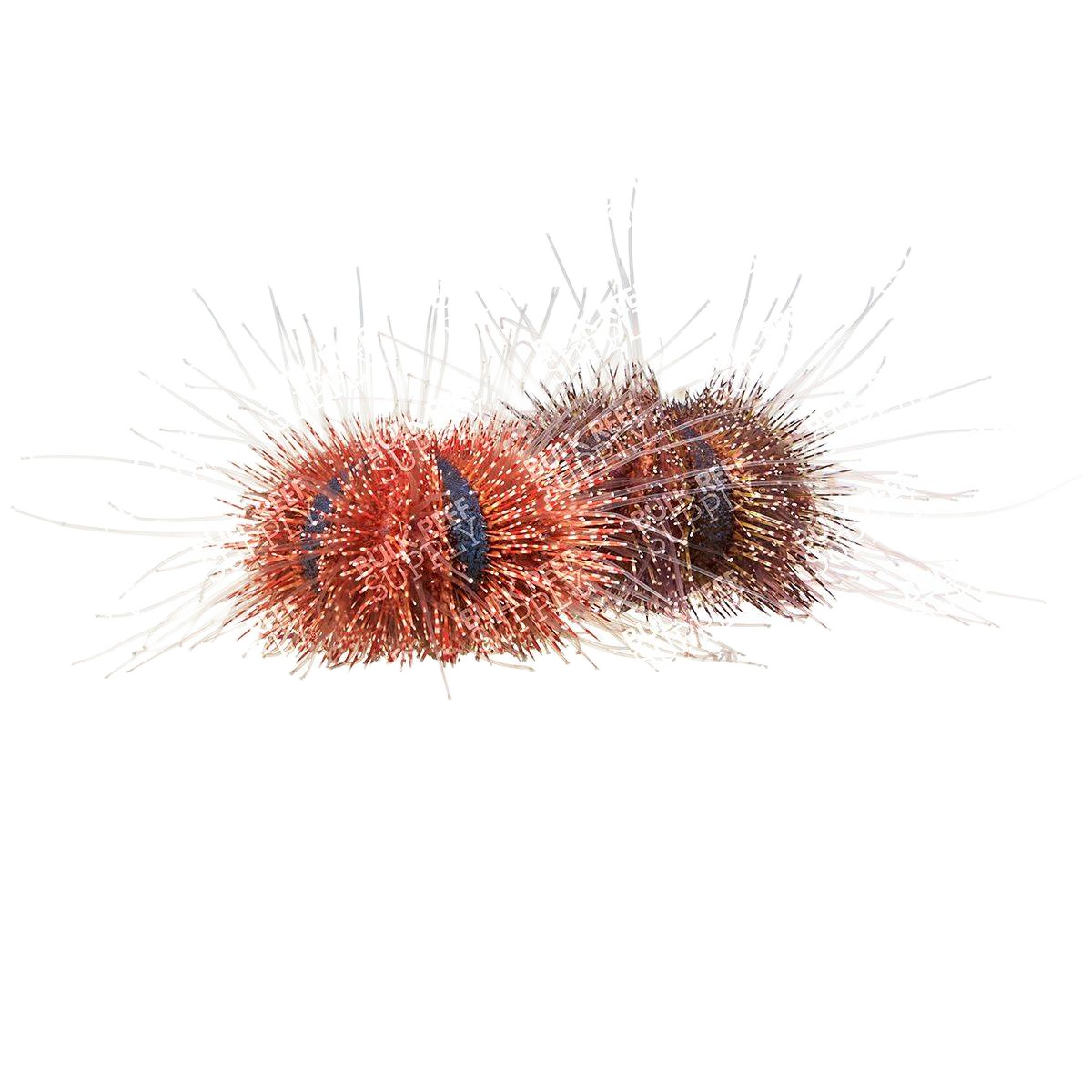
The ORA Tuxedo Urchin (Mespilia globulus) has formal-looking blue bands separating its short, multicolored spines and comes in two color varieties: the Red Tuxedo with dramatic red spines and the Blue Tuxedo with darker blue. Mostly nocturnal, it hides in rockwork and emerges at night to consume nuisance algae from hard-to-reach places; an easy, peaceful, reef-safe herbivore for tanks of 20 gallons or larger — provide plenty of live rock, feed supplemental foods only if algae runs low, note it will also consume beneficial macroalgae, and expect its charming camouflage habit of carrying shells and rubble on its spines to rearrange your aquascape.
Quick facts
Handling caution: Spines are short and blunt but can still pinch or lightly puncture skin; not seriously venomous
Identity
- Also known as
- Sphere Urchin; Globe Urchin; Blue Tuxedo Urchin; Pincushion Urchin
- Synonyms
- Temnopleurus globulus
- Environment
- Saltwater
- Native to
- Indo-Pacific, Red Sea, East Africa, Indonesia, western Pacific
- Habitat
- Shallow reef flats and rubble zones in the Indo-Pacific, where it grazes on algae-covered rock and coral rubble
- Sourcing
- Both
- Conservation
- Not Evaluated
Care
- Care level
- Easy
- Temperament
- Peaceful
- Adult size
- 1 – 3 in (2.5 – 7.6 cm)
- Lifespan
- 3 – 5 yrs
- Min tank
- 20 gal (76 L)
- Growth rate
- Slow
- Placement
- Bottom, Rock & glass
Water
- Temperature
- 72 – 79 °F (22 – 26 °C)
- pH
- 8.1 – 8.4
- dKH
- 8 – 12 dKH
- Salinity
- 1.023 – 1.026 SG
- Flow
- Moderate
Behavior & compatibility
- Social
- Solitary
- Aggression to own kind
- Low
- Active
- Night
- Reef safe
- With caution
- Invert safe
- With caution
- Shrimp safe
- Yes
- Clean-up role
- Algae, Biofilm
- Population boom risk
- Low
Feeding & breeding
- Diet
- Herbivore
- Foods
- Algae, Freeze-dried, Vegetables
- Breeding type
- Broadcast spawner
- Breeding difficulty
- Not bred in captivity
- Sexing
- External sexual dimorphism is not visible; sexes cannot be distinguished by appearance
- Target feeding
- Beneficial
Something wrong or missing? Submit a correction
Care guide
Overview
Growing to roughly 1 to 3 inches, this small globular urchin shows blue banding between short spines that vary from red to darker blue depending on the individual offered. Nocturnal by nature, it stays tucked in rockwork by day and roams rock and glass at night stripping algae film. A 20-gallon or larger reef with established live rock and copper-free, stable water suits it best.
Care
A hardy grazer suited to established reef tanks with mature rockwork offering plenty of film and turf algae. It spends daylight hours tucked into crevices and becomes active at night, wandering across rock and glass while nibbling algae. Water stability matters more than exact parameters, and slow drip acclimation is essential since sudden shifts in salinity or temperature can cause spine loss or death. Copper-based medications must never be used in a tank housing this urchin, as they are lethal to echinoderms.
Feeding
In a tank with abundant film algae and diatoms, supplemental feeding is rarely necessary, but once natural grazing runs low it should be offered dried seaweed or algae wafers placed near its usual resting spot. It will also graze on coralline algae and some macroalgae if nothing else is available, which can be undesirable in tanks where coralline growth is prized. Watch body condition and spine density over time, since a visually clean tank can still be food-poor for the animal.
Tank mates
Generally peaceful and safe with fish, corals, and most other invertebrates, though it has a habit of picking up loose shells, rubble, and even small coral frags to wear as camouflage. Any valuable or unsecured frags should be glued down firmly, since the urchin can dislodge or bury them while wandering. It does best kept singly or in pairs in larger systems, as multiple individuals compete for the same limited algae supply.
Breeding
Breeding in home aquariums has not been documented, and reproduction relies on broadcast spawning with external fertilization in open water. Larvae are planktonic and require conditions that are impractical to replicate outside of a laboratory or aquaculture facility. Nearly all specimens in the trade are wild-collected or farmed from wild broodstock rather than captive-bred.
Health
Spine loss is the clearest early warning sign of declining health, usually triggered by poor water quality, elevated nitrate, or an abrupt change in salinity or temperature during acclimation. Exposure to copper-based medications is invariably fatal and should be treated as an absolute no. A urchin that stops moving, loses its grip on surfaces, or shows a deflated test may be in serious decline and warrants immediate water testing.
Sources
Varieties in the catalog
Something wrong or missing? Submit a correction
In the community
Popular tanks using ORA Tuxedo Urchin - Assorted Color
No public tanks are showcasing ORA Tuxedo Urchin - Assorted Color yet.