
Coral
ORA Space Invader Pectinia Coral
Pectinia sp.MerulinidaePectinia corals
Add from My tanks →1 photos
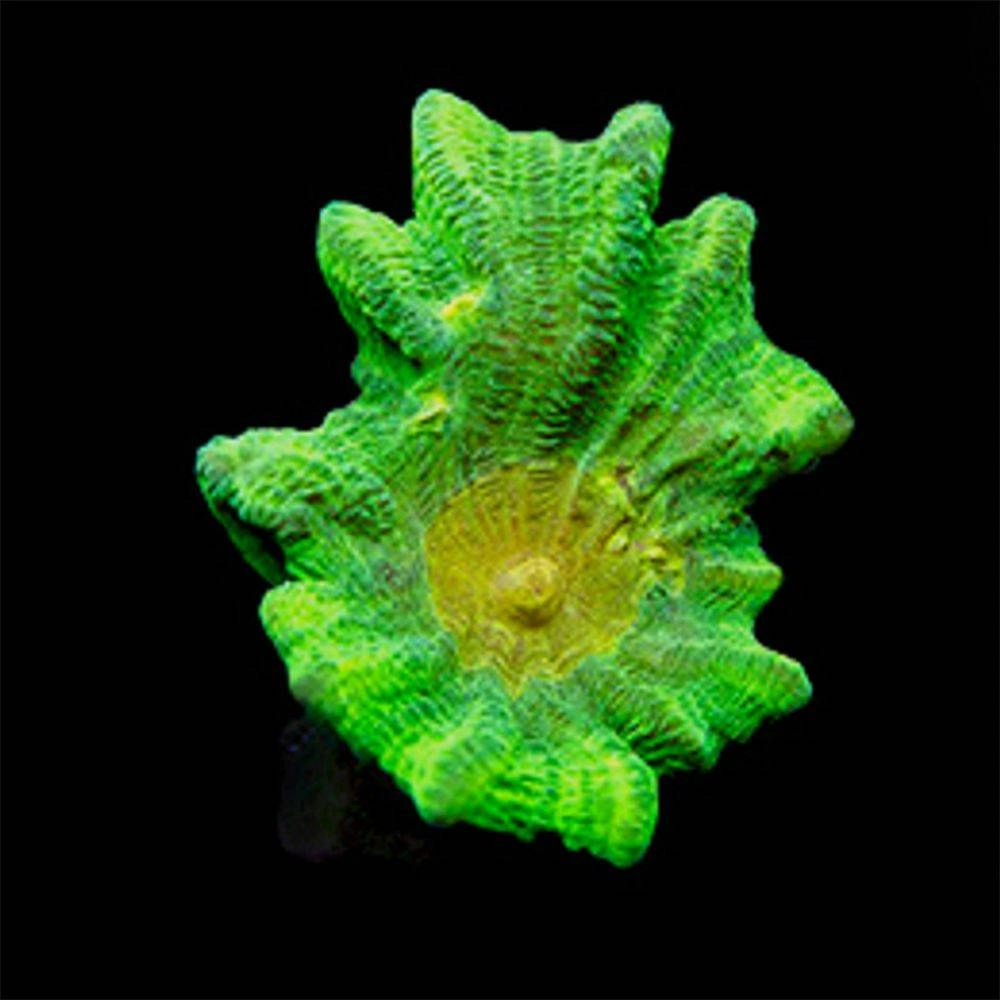
The ORA Space Invader Pectinia has bold yellow and green colors that stand out in any reef tank. It grows in wavy folds and does best in low to moderate light with gentle flow; leave some space around it, as it can extend sweeper tentacles at night.
Quick facts
Handling caution: Can sting neighboring corals with sweeper tentacles; wear gloves to avoid skin irritation from nematocysts
Identity
- Also known as
- Antler coral; Leaf coral
- Synonyms
- Pectinia lactuca (misapplied in trade)
- Environment
- Saltwater
- Native to
- Indo-Pacific, Western Central Pacific
- Habitat
- Lower reef slopes and turbid, muddy or rubble bottoms, typically on horizontal or gently sloped surfaces in deeper, low-light water
- Sourcing
- Both
- Conservation
- Not Evaluated
Care
- Care level
- Easy
- Coral type
- LPS
- Temperament
- Semi-Aggressive
- Growth form
- Plating
- Adult size
- 1.5 – 8 in (3.8 – 20 cm)
- Spread
- 12 in (30 cm)
- Growth rate
- Moderate
- Placement
- Sand bed, Low
Water
- Temperature
- 76 – 80 °F (24 – 27 °C)
- pH
- 8.1 – 8.4
- dKH
- 8 – 12 dKH
- Salinity
- 1.025 – 1.026 SG
- PAR
- 50 – 150 PAR
- Flow
- Low-Moderate
- Light
- Low
Reef care
- Nutrient preference
- Medium
- Alk/Ca uptake
- Medium
- Target feeding
- Beneficial
- Give it room
- 4 in (10 cm)
- Colors
- Green, Yellow
Feeding & breeding
- Diet
- Photosynthetic
- Foods
- Coral food, Phytoplankton, Zooplankton, Frozen
- Propagation
- Fragging
Something wrong or missing? Submit a correction
Care guide
Overview
Space Invader is an aquacultured Pectinia alcicornis color morph developed by ORA, showing green and yellow tones across plating, folded tissue. It spreads across the sandbed or a flat ledge rather than encrusting rock, and puts out sweeper tentacles after dark, so nearby corals need clearance. A hardy, low-light LPS suited to most reef setups once acclimated slowly.
Care
Pectinia is a hardy LPS that tolerates a wide range of flow and lighting once acclimated slowly, though it colors up best under low to moderate light around 50-150 PAR. Give it open space on the sandbed or a flat ledge in the lower half of the tank since its plates and pillars extend sweeper tentacles at night that can reach nearby corals. Moderate, somewhat random flow keeps detritus from settling in its folds without damaging the delicate tissue.
Placement & acclimation
Acclimate to lighting slowly since sudden increases in intensity can cause bleaching. Place the frag or colony on the sandbed or a flat rocky ledge in the lower to middle part of the tank, since it does not encrust rock like many other corals and needs a stable horizontal surface to spread over.
Feeding
This coral gets most of its energy from photosynthesis but responds well to supplemental feeding in nutrient-poor systems. Fine particulate foods such as phytoplankton, amino acid dosing, or dosed zooplankton work better than direct spot feeding since the corallite mouths are small. It generally does better with a bit more dissolved nutrient in the water column than ultra-clean reef systems provide.
Neighbors
Keep several inches of clearance between Pectinia and neighboring corals, since it puts out sweeper tentacles that can sting sessile invertebrates within reach. It is not aggressive toward fish and pairs fine with most reef tank inhabitants, but avoid placing it near slow-growing or immobile corals that cannot be moved away if contact occurs. Avoid crowding it against other semi-aggressive LPS that could sting back.
Fragging
Frags are produced by cutting or carefully snapping off sections of the plating branches or pillars, which is relatively straightforward compared to many other LPS. Allow cut edges to heal in stable, low-flow conditions before moving frags to their permanent spot.
Pests & problems
Tissue can appear tight or puffed depending on flow, light, and feeding, without this necessarily indicating a problem. Bleaching risk increases if lighting is pushed too high too quickly, so acclimate new colonies gradually. Watch for flatworms or nudibranchs that occasionally target LPS corals and inspect new frags before adding them to the display.
Sources
Something wrong or missing? Submit a correction
In the community
Popular tanks using ORA Space Invader Pectinia Coral
No public tanks are showcasing ORA Space Invader Pectinia Coral yet.