
Coral
ORA Ponape Birdsnest Coral
Seriatopora hystrixPocilloporidaeBirdsnest corals
Add from My tanks →1 photos
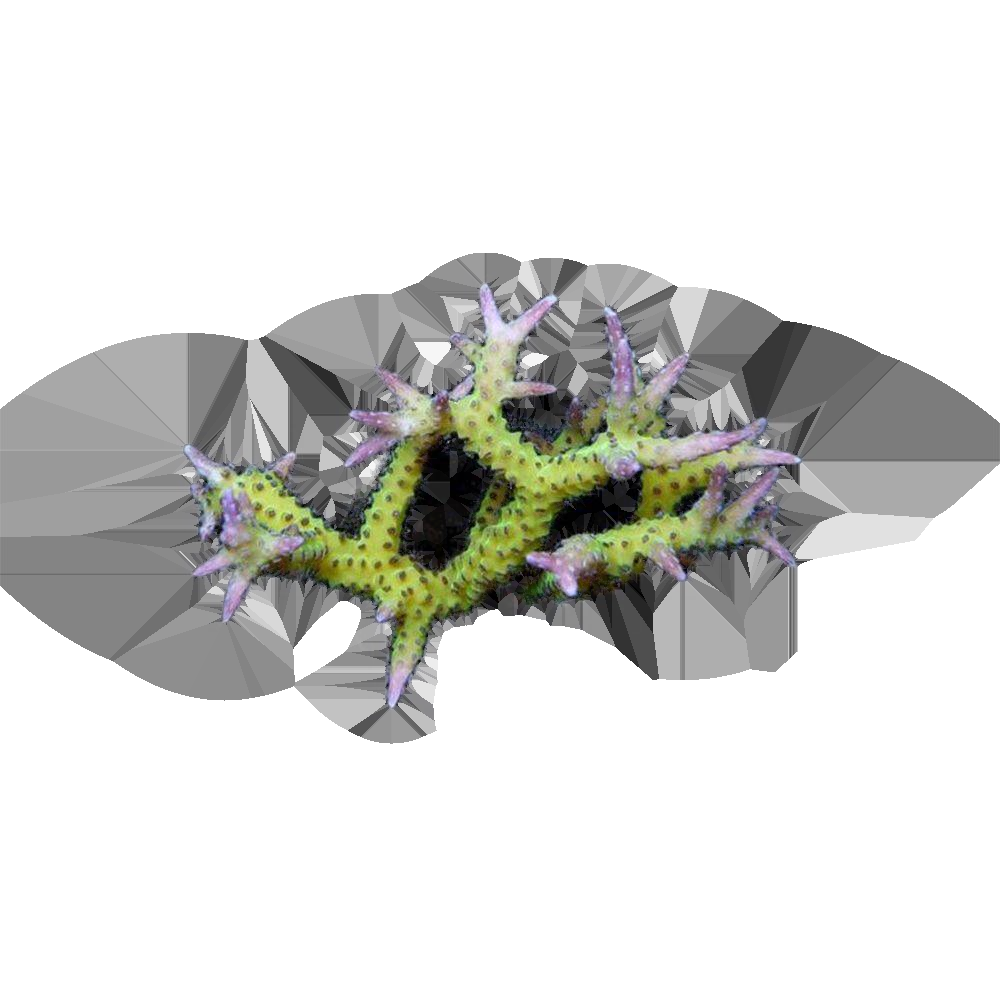
The ORA Ponape Birdsnest Coral is an SPS coral with light green branches and pink tips forming a compact, dense structure. It grows relatively quickly, adapts to a range of lighting conditions, and often shows stronger green coloration under slightly lower light.
Quick facts
Handling caution: Short stinging sweeper tentacles; branches are sharp and brittle and can cut skin.
Identity
- Also known as
- Ponape birdsnest; Green birdsnest coral
- Synonyms
- Seriatopora angulata; Seriatopora dentritica
- Environment
- Saltwater
- Native to
- Indo-Pacific, Red Sea, Great Barrier Reef, Indonesia, Philippines
- Habitat
- Shallow reef flats, lagoons and intertidal reef terraces with high light and variable water motion; grows thicker branches in high wave energy and finer branches in sheltered areas.
- Sourcing
- Both
- Conservation
- Near Threatened
Care
- Care level
- Moderate
- Coral type
- SPS
- Temperament
- Semi-Aggressive
- Growth form
- Branching
- Adult size
- 2 – 8 in (5.1 – 20 cm)
- Spread
- 12 in (30 cm)
- Growth rate
- Fast
- Placement
- Middle, High
Water
- Temperature
- 75 – 80 °F (24 – 27 °C)
- pH
- 8.1 – 8.4
- dKH
- 8 – 9.5 dKH
- Salinity
- 1.025 – 1.026 SG
- PAR
- 200 – 350 PAR
- Flow
- Moderate-High
- Light
- High
Reef care
- Nutrient preference
- Low
- Alk/Ca uptake
- High
- Target feeding
- Beneficial
- Give it room
- 3 in (7.6 cm)
- Colors
- Green, Pink, Purple, Blue, Cream, Multicolor
Feeding & breeding
- Diet
- Photosynthetic
- Foods
- Frozen, Zooplankton, Phytoplankton, Coral food
- Propagation
- Fragging
Something wrong or missing? Submit a correction
Care guide
Overview
Light green branches tipped in pink form a compact, densely packed colony typical of this aquacultured strain. Growth is fast for a birdsnest coral and it tolerates a range of lighting, often deepening its green tone when light intensity is kept moderate rather than intense. Best sited with clearance from neighbors given its sweeper tentacles.
Care
This finely branched SPS forms dense, bushy colonies and colors up best under stable, moderate-to-high light with strong, turbulent flow reaching the inner branches. It is more sensitive to swings in alkalinity, temperature and nutrients than many other SPS, often responding to instability with tissue recession or branch tip bleaching. Because branches are thin and brittle, handle frags by the base or plug rather than the tips, and avoid placing new tanks under a year old before adding this species.
Placement & acclimation
Mount frags securely on rock or a plug in the upper-middle to high zone of the tank where strong, turbulent flow can reach between the branches. Acclimate new colonies to light gradually over one to three weeks, starting at lower intensity, since sudden increases can cause bleaching. Position with several inches of open space from other corals to avoid stinging contact and self-shading as the colony fills in.
Feeding
Most nutrition comes from photosynthesis via zooxanthellae, but growth and coloration benefit from occasional feeding of very fine particulate foods such as rotifers, copepod nauplii, phytoplankton or powdered coral foods. Because the polyps are small with limited prey-capture ability, larger frozen foods are not usable; keep feedings to fine particle sizes a few times a week. In a well-stocked, well-fed reef tank with good ambient plankton and dissolved organics, supplemental feeding is often unnecessary.
Neighbors
Give this coral several inches of clearance from neighbors, as its branches carry short stinging sweeper tentacles and can release chemical defenses to compete for space. It can hold its own against peaceful corals but may lose ground to more aggressive species with longer sweepers such as euphyllia or galaxea. As colonies enlarge, outer branches can shade or block flow to the interior, so periodic pruning or fragging helps maintain even growth and coloration.
Fragging
Fragging is done by cutting or snapping branches with bone shears and mounting the pieces on plugs or rubble; healed cuts regenerate quickly given stable conditions. Colonies can also reproduce via polyp bail-out under stress, where detached polyps drift and occasionally settle to form new colonies, though this is uncommon in captivity for this species.
Pests & problems
Watch for Seriatopora-eating nudibranchs and small crustacean pests that can hide deep within the branch clusters and cause tissue loss. Rapid changes in light, flow or water chemistry are the most common causes of paling, bleaching, or rapid/slow tissue necrosis (RTN/STN) in this species. Under very low nutrient conditions colonies can pale, while excess nutrients tend to cause browning, so stable, moderate nutrient levels are preferred.
Sources
Varieties in the catalog
Something wrong or missing? Submit a correction
In the community
Popular tanks using ORA Ponape Birdsnest Coral
No public tanks are showcasing ORA Ponape Birdsnest Coral yet.