
Freshwater Fish
Neon Tetra
Paracheirodon innesiCharacidaeTetras
Add from My tanks →1 photos
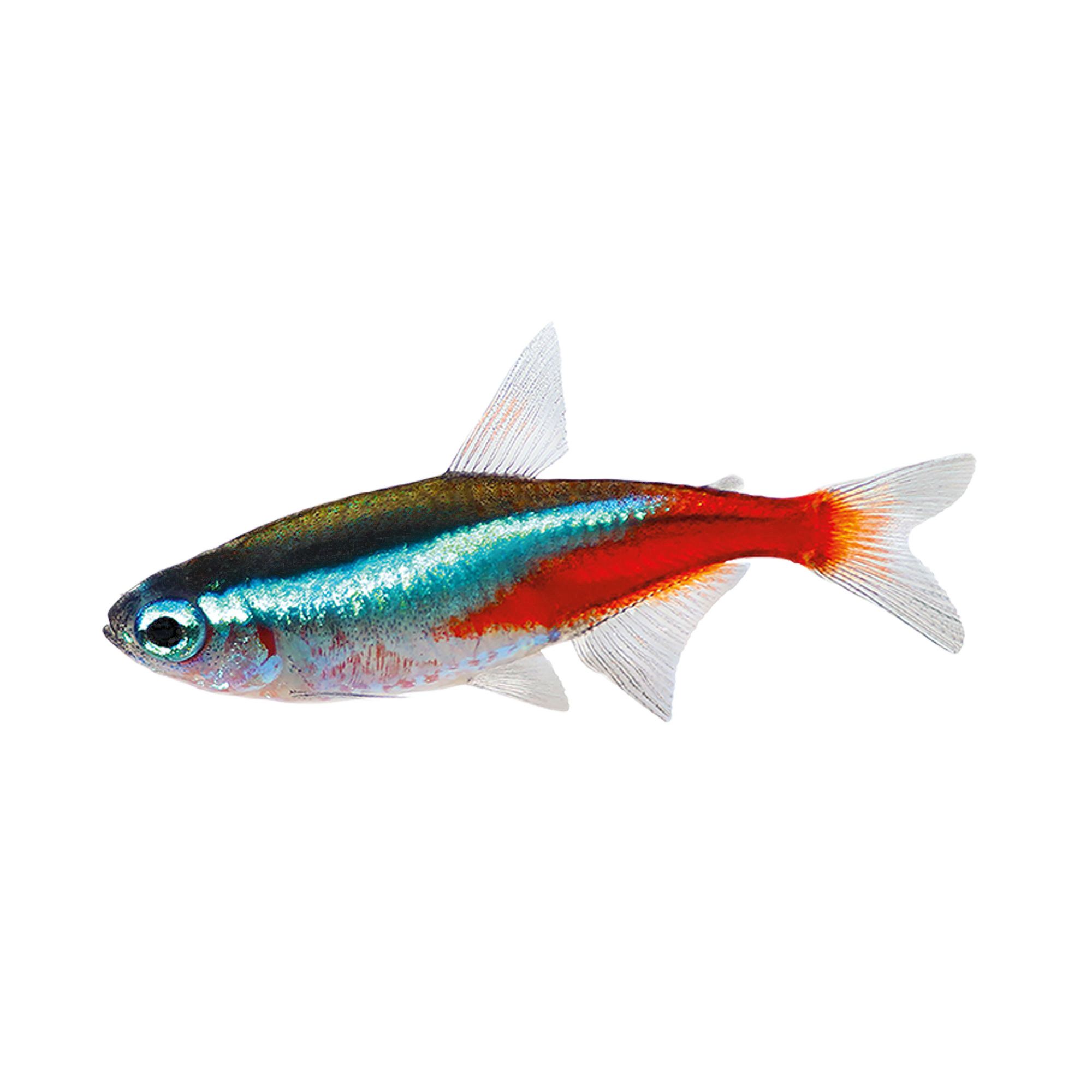
A Neon tetra (Paracheirodon innesi), the classic small tetra with iridescent blue and red stripes; peaceful and best kept in large schools.
Quick facts
Identity
- Also known as
- Innesi neon
- Synonyms
- Hyphessobrycon innesi
- Environment
- Freshwater
- Native to
- Colombia, Peru, Brazil
- Habitat
- Blackwater and clearwater forest streams and tributaries of the western Amazon basin, typically acidic, soft, tannin-stained water with dense marginal vegetation and submerged roots.
- Sourcing
- Captive-bred
- Conservation
- Not Evaluated
Care
- Care level
- Easy
- Temperament
- Peaceful
- Adult size
- 1 – 1.5 in (2.5 – 3.8 cm)
- Lifespan
- 3 – 5 yrs
- Min tank
- 10 gal (38 L)
- Growth rate
- Moderate
- Placement
- Middle
Water
- Temperature
- 70 – 77 °F (21 – 25 °C)
- pH
- 5.0 – 7.0
- GH
- 1 – 10 dGH
- Flow
- Low
Behavior & compatibility
- Social
- Shoaling · groups of 6+
- Aggression to own kind
- Low
- Active
- Daytime
- Plant safe
- Yes
- Shrimp safe
- With caution
Feeding & breeding
- Diet
- Omnivore
- Foods
- Flakes, Micro-pellets, Frozen, Live, Freeze-dried, Algae
- Breeding type
- Egg scatterer
- Breeding difficulty
- Difficult
- Sexing
- Females are typically plumper with a more rounded belly and a slightly bent blue lateral line, while males are slimmer with a straighter blue stripe; differences are subtle outside of breeding condition.
Something wrong or missing? Submit a correction
Care guide
Overview
Paracheirodon innesi is a small characin defined by a horizontal iridescent blue stripe running from nose to adipose fin, met by a red band along the rear half of the body. Best kept in groups of six or more, it stays under 1.5 inches and prefers soft, acidic, dimly lit water with cover from plants and driftwood.
Care
Neon tetras do best in a well-planted tank with subdued lighting, soft substrate, and driftwood that mimics their blackwater origins. They are hardy once acclimated but are sensitive to sudden shifts in water chemistry, so stable parameters matter more than hitting an exact number. A tight-fitting lid is worthwhile since they can startle and jump when spooked.
Feeding
Small mouths limit them to fine foods such as micro-pellets, crushed flake, and finely chopped frozen bloodworm or baby brine shrimp. Feeding small portions once or twice daily prevents waste buildup and keeps the whole shoal fed evenly. As midwater feeders they largely ignore food that falls to the substrate, so pairing them with bottom-dwelling species helps clean up leftovers.
Tank mates
Best kept with other small, calm community fish such as corydoras, rasboras, and other peaceful tetras that share similar water preferences. Avoid boisterous or nippy tankmates like tiger barbs, and steer clear of larger predatory fish including adult angelfish that will eat them despite being commonly sold together in stores. Their small size makes them vulnerable, so tankmates should be chosen with restraint and similar temperament in mind.
Breeding
Spawning is triggered by very soft, acidic water, dim lighting, and a dedicated breeding tank free of substrate disturbance. A conditioned pair scatters a small number of adhesive eggs over fine-leaved plants or spawning mops, with fry emerging within about a day. Eggs and fry are highly sensitive to light and water quality, making this a project better suited to experienced breeders.
Health
The species is particularly known for susceptibility to neon tetra disease, caused by the parasite Pleistophora hyphessobryconis, which is untreatable and can spread through a shoal. Quarantining newly purchased neons for two to three weeks before introducing them to an established tank reduces this risk considerably. Sourcing fish from a reputable supplier with healthy stock also lowers the incidence of the morphological weaknesses seen in mass-bred lines.
Sources
Varieties in the catalog
Something wrong or missing? Submit a correction
In the community
Popular tanks using Neon Tetra
No public tanks are showcasing Neon Tetra yet.