
Marine Invertebrates
Mini Carpet Anemone
Stichodactyla tapetumStichodactylidaeAnemones
Price: $56.40 USD
Add from My tanks →1 photos
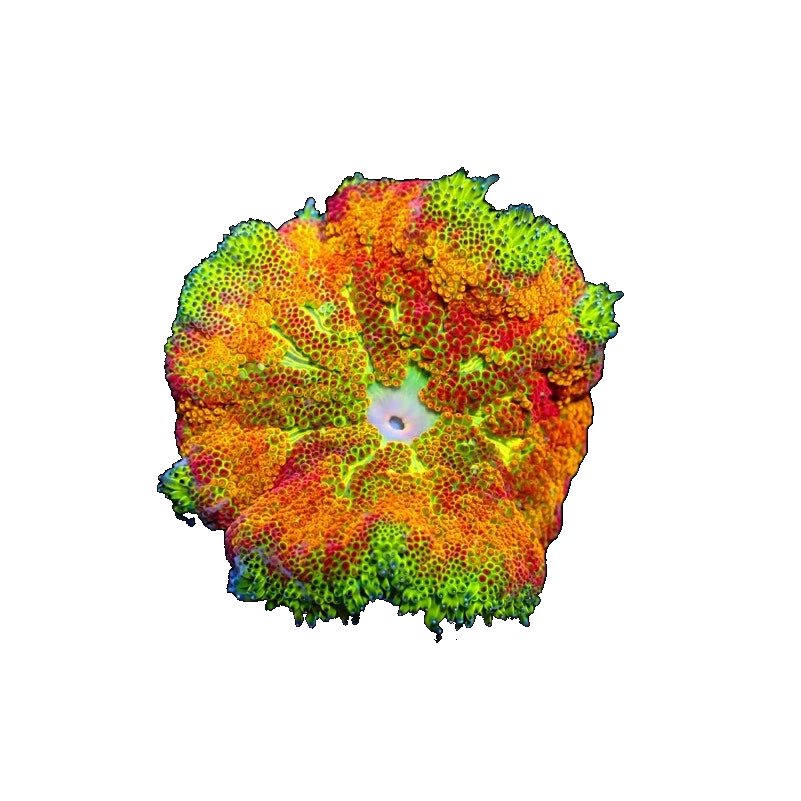
The Mini Carpet Anemone (Stichodactyla tapetum) comes in a rainbow of knockout color forms and turns rockwork into an artistic aquascape. It is small and easy to keep, not known to host clownfish, and requires a fully established aquarium with strong lighting, good water movement, and weekly or daily feeding with meaty foods; handle with care since it can cause a severe skin reaction.
Quick facts
Handling caution: Venomous sting can cause a severe skin reaction in sensitive people; handle with care
Identity
- Also known as
- Rock Anemone; Pizza Anemone
- Synonyms
- Stoichactis tapetum
- Environment
- Saltwater
- Native to
- Red Sea, East Africa, Indo-Pacific, Great Barrier Reef, southern Japan, Vietnam
- Habitat
- Shallow tide pools and rubble zones on sandy or rocky bottoms in the top few meters of sheltered reef flats
- Sourcing
- Wild-caught
- Conservation
- Not Evaluated
Care
- Care level
- Moderate
- Temperament
- Semi-Aggressive
- Adult size
- 1 – 4 in (2.5 – 10 cm)
- Lifespan
- 5 – 20 yrs
- Min tank
- 20 gal (76 L)
- Growth rate
- Moderate
- Placement
- Bottom
Water
- Temperature
- 75 – 82 °F (24 – 28 °C)
- pH
- 8.1 – 8.4
- dKH
- 8 – 12 dKH
- Salinity
- 1.023 – 1.025 SG
- Flow
- Moderate
Behavior & compatibility
- Social
- Colony
- Aggression to own kind
- Low
- Active
- Daytime
- Reef safe
- With caution
- Invert safe
- With caution
- Shrimp safe
- With caution
- Clean-up role
- Pest control
- Population boom risk
- Low
Feeding & breeding
- Diet
- Carnivore
- Foods
- Frozen, Zooplankton, Live
- Breeding type
- Broadcast spawner
- Breeding difficulty
- Difficult
- Sexing
- No external sexual dimorphism; reproduces mainly by asexual fission in captivity
- Target feeding
- Beneficial
Something wrong or missing? Submit a correction
Care guide
Overview
Found across the Indo-Pacific and Red Sea in shallow tide pools and rubble flats, this compact anemone anchors its pedal disc to rock or sand and rarely relocates once settled. Colonies form clusters through asexual fission, with a short oral disc rarely exceeding four inches. Strong light and moderate flow keep it healthy, and its sting warrants caution around fish, corals, and bare skin.
Care
This anemone is smaller and generally more forgiving than its larger Stichodactyla relatives, but it still needs a mature, chemically stable reef tank rather than a newly cycled one. Strong lighting is required to support the zooxanthellae it relies on for much of its energy, and moderate to strong water flow helps keep its disc clean and expanded. Provide a mix of live rock and sandy substrate so it can attach its foot securely, since once it wedges itself into a crevice it becomes very difficult to relocate without causing damage.
Feeding
Feed small meaty items such as chopped fish, mysis, brine shrimp, or bits of raw shrimp several times a week, since photosynthesis alone will not sustain long term health. Offer pieces small enough to be drawn fully into the mouth, as oversized chunks may be rejected and foul the water. Regular feeding tends to improve coloration and encourages the animal to remain settled in one spot.
Tank mates
Its sting is disproportionately strong for its size, so keep a buffer of open space between it and corals or other anemones that could be stung during nighttime tentacle extension. It is not considered a natural host for clownfish and rarely accepts one in captivity, though small commensal shrimp such as Periclimenes and Thor species will often take up residence on it. Avoid pairing it with easily stung soft corals or LPS placed too close on the same rockwork.
Breeding
Reproduction in aquariums occurs almost exclusively through pedal laceration or binary fission, producing genetically identical clone colonies over time. Sexual reproduction via broadcast spawning is known in the wild but is not something hobbyists can reliably induce or witness in a home tank. Given enough time and stable conditions, a single specimen can slowly multiply into a cluster on the same rock.
Health
Anemones that repeatedly wander the tank are usually signaling dissatisfaction with lighting, flow, or water quality, and forcing them to stay put by trapping them can cause fatal injury. Deflation or bleaching of the tissue points to insufficient light or a recent water quality swing, both of which should be corrected quickly since decline can be rapid once it starts. A dead or dying anemone releases toxins that can crash a tank, so any individual that will not stop deteriorating should be removed promptly.
Sources
More Anemones
Something wrong or missing? Submit a correction
In the community
Popular tanks using Mini Carpet Anemone
No public tanks are showcasing Mini Carpet Anemone yet.