
Soft Corals
Metallic Green Star Polyp Coral (GSP)
Pachyclavularia violaceaClavulariidaeStar polyps
Price: $21.15 USD
Add from My tanks →1 photos
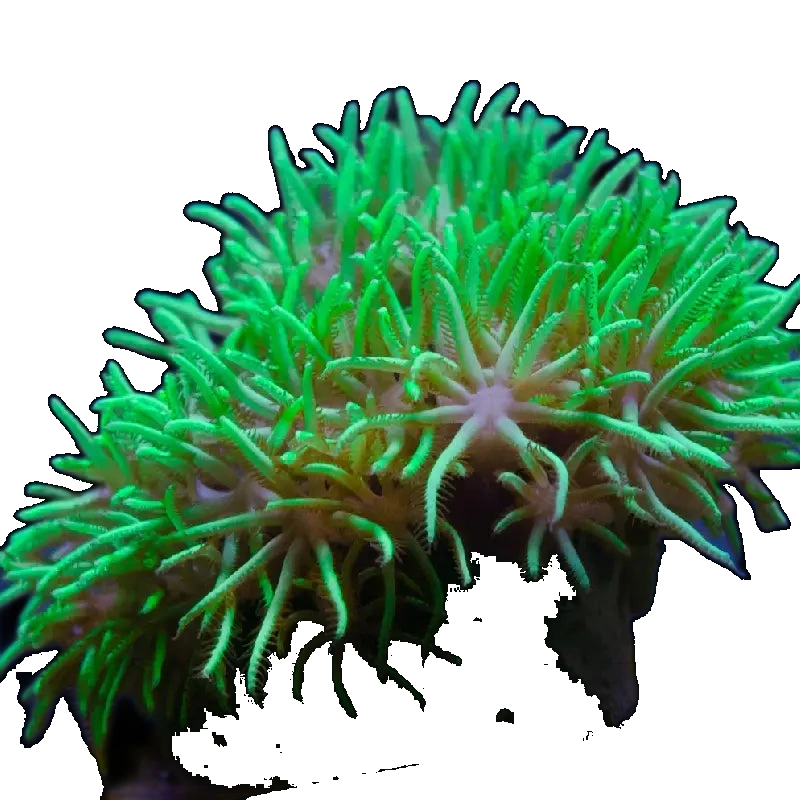
Metallic Green Star Polyps (Pachyclavularia violacea) are hardy, fast-growing soft corals with vivid metallic-green polyps over a purple or reddish encrusting mat, creating a grass-like appearance. They tolerate a range of conditions and spread rapidly over hard surfaces, so isolated placement and regular trimming help keep them from overtaking slower-growing corals.
Quick facts
Identity
- Also known as
- GSP; Star Polyps; Green Star Polyp Mat; Metallic Green Star Polyps
- Synonyms
- Clavularia violacea; Briareum violaceum
- Environment
- Saltwater
- Native to
- Fiji, Tonga, Solomon Islands, Indo-Pacific, Great Barrier Reef
- Habitat
- Shallow reef flats and lagoons where it encrusts rock, rubble, and other hard substrates in well-lit, current-swept water
- Sourcing
- Aquacultured
- Conservation
- Not Evaluated
Care
- Care level
- Easy
- Coral type
- Soft
- Temperament
- Semi-Aggressive
- Growth form
- Encrusting
- Adult size
- from 1 in (2.5 cm)
- Spread
- 24 in (61 cm)
- Growth rate
- Fast
- Placement
- Low, Middle
Water
- Temperature
- 76 – 80 °F (24 – 27 °C)
- pH
- 8.1 – 8.4
- dKH
- 8 – 10 dKH
- Salinity
- 1.024 – 1.026 SG
- PAR
- 50 – 150 PAR
- Flow
- Moderate
- Light
- Medium
Reef care
- Nutrient preference
- Medium
- Alk/Ca uptake
- Low
- Target feeding
- Beneficial
- Give it room
- 4 in (10 cm)
- Colors
- Green, Purple
Feeding & breeding
- Diet
- Photosynthetic
- Foods
- Frozen, Phytoplankton, Zooplankton, Coral food
- Propagation
- Fragging
Something wrong or missing? Submit a correction
Care guide
Overview
Wild colonies of this species encrust shallow, current-swept reef flats across the Indo-Pacific, and aquacultured frags now dominate the hobby trade. A purple mat carries dense metallic-green polyps that give a grass-like carpet effect over rock or glass. Fast-spreading and easy, it needs isolation from slower corals and periodic trimming to prevent overgrowth.
Care
Green star polyps encrust rock, glass, and overflow boxes with a thin purple mat topped by extending green polyps. It adapts to a wide range of light and flow but does best under moderate lighting and moderate, varied current that keeps the mat free of detritus and film algae. Stability of parameters matters more than any particular value, since sudden swings in salinity or alkalinity can cause the mat to recede or sulk.
Placement & acclimation
Frags are typically attached to a small rock or plug with coral-safe cyanoacrylate gel and set on an isolated island of rock or the aquarium's back wall to contain spread. Light-acclimate new colonies gradually over a week using shade or a reduced photoperiod to prevent bleaching, and dip before introduction to screen for pests. Position with good flow around the base to prevent detritus from settling on the mat.
Feeding
Most of its nutrition comes from zooxanthellae, so no direct feeding is required in a well-lit tank. Occasional dosing of phytoplankton or fine particulate coral foods during a lull in flow can boost polyp extension and coloration. Overfeeding is unnecessary and can contribute to nuisance nutrient levels without much visible benefit.
Neighbors
Because it spreads quickly over any hard surface, it is best kept on an isolated rock or frag plug set apart from the main aquascape, with several inches of clearance from slower-growing neighbors. It does not carry strong sweeper tentacles but can smother or outcompete corals it grows over given enough time. Fast stinging corals such as torches or hammers can damage the polyp mat if placed too close, so give both sides room.
Fragging
GSP is one of the easiest corals to frag: a sharp blade or scissors can cut a section of the mat along with its rock backing, which is then glued to a new plug or rock. Cut pieces reattach and resume growth within days to weeks under stable conditions, making it a common aquacultured starter coral.
Pests & problems
Closed or retracted polyps for an extended period usually point to low or stagnant flow, algae film smothering the mat, or a recent parameter shift rather than disease. Bleaching or pale patches can result from excessive light without proper acclimation, while patchy die-off along the mat's edge is often tied to shading or detritus buildup. Pest hitchhikers such as sundial snails or nudibranchs occasionally target GSP mats and should be checked for during a pre-dip inspection.
Sources
Something wrong or missing? Submit a correction
In the community
Popular tanks using Metallic Green Star Polyp Coral (GSP)
No public tanks are showcasing Metallic Green Star Polyp Coral (GSP) yet.