
Aquatic Plant
Hydrocotyle Sibthorpioides
Hydrocotyle sibthorpioidesAraliaceaePennyworts
Price: $24.99 USD
Add from My tanks →1 photos
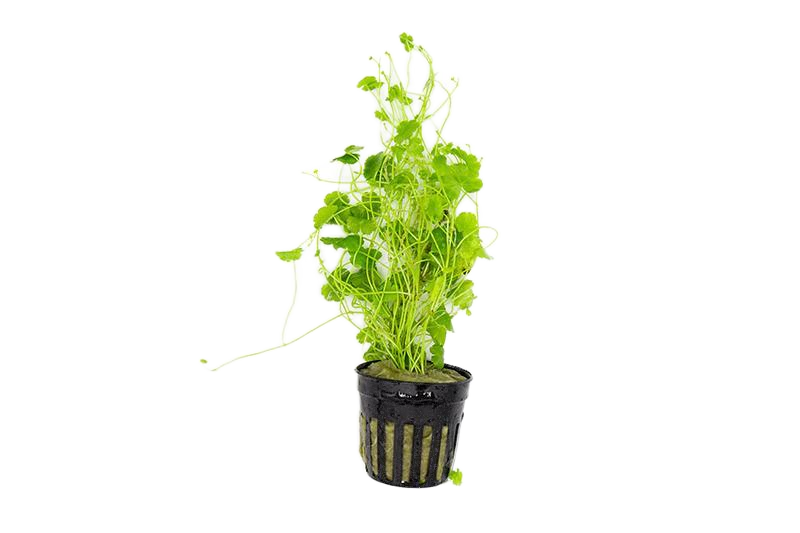
Hydrocotyle Sibthorpioides, commonly known as Lawn Marsh Pennywort, is a charming little aquatic plant native to Asia with delicate, rounded, clover-like leaves. Run it as a low-growing foreground carpet under high light and CO2, bush it in the midground, or trail it across hardscape; fast-growing for lush greenery sooner.
Quick facts
Identity
- Also known as
- Lawn Pennywort; Dwarf Pennywort
- Synonyms
- Hydrocotyle sibthorpioides var. batrachium; sold in trade as "Hydrocotyle maritima" (misapplied)
- Environment
- Freshwater
- Native to
- Asia, Tropical Africa
- Habitat
- Damp margins of ditches, streams, wet meadows, rice paddies, and riverbanks; grows both submerged and emersed in warm tropical and subtropical climates
- Sourcing
- Aquacultured
- Conservation
- Not Evaluated
Care
- Care level
- Moderate
- Growth form
- Carpeting
- Max height
- 4 in (10 cm)
- Growth rate
- Moderate
- Placement
- Foreground, Midground, Carpet
Water
- Temperature
- 68 – 82 °F (20 – 28 °C)
- pH
- 5.5 – 7.5
- GH
- 4 – 15 dGH
- dKH
- 2 – 10 dKH
- Flow
- Low-Moderate
- Light
- High
- CO₂
- Required
Planting
- Substrate
- Nutrient-rich preferred
- Feeds from
- Both
- Fertilizer needs
- High
- Colors
- Green
Feeding & breeding
- Propagation
- Runners, Cuttings
Something wrong or missing? Submit a correction
Care guide
Overview
Small rounded leaves rarely exceed a few inches in height, forming a low mat that spreads by surface runners across the substrate. Under high light and steady CO2 it stays dense and carpet-like; without both it stretches upward and thins out. Regular trimming keeps the mat compact and prevents basal rot in shaded lower growth.
Care
This creeping pennywort needs strong light and consistent CO2 injection to stay low and dense; without both it stretches upward on long petioles and loses the carpet effect. It tolerates a wide temperature range but performs best in the high 60s to mid 70s Fahrenheit with soft to moderately hard water. Regular trimming every two to four weeks keeps the mat from shading out its own lower leaves and rotting at the base.
Planting & trimming
Plant small groups of individual stems spaced a couple of inches apart directly into the substrate, anchoring with pebbles or tweezers if needed, and allow the runners to spread and knit together over time. It can also be draped over hardscape such as wood and rocks to fill gaps between features. Trim with sharp scissors regularly to maintain a compact mat and prevent leggy vertical growth.
Fertilizing
Feeds through both roots and leaves, so a nutrient-rich substrate paired with regular liquid fertilization works well. Keep phosphate levels on the higher side, as this helps prevent green spot algae from colonizing the small round leaves. Nitrogen and potassium deficiencies show up as yellowing foliage and small pinholes, so consistent dosing of a complete micronutrient fertilizer including iron is recommended.
Propagation
Propagates readily from the lateral runners (stolons) it produces along the substrate; simply cut a runner section with a few nodes and replant it elsewhere. Emersed cultivation above the waterline, such as in a paludarium or during warm outdoor months, speeds growth considerably and yields more cuttings faster than fully submerged culture.
Problems
Melting and stem rot occur quickly in low light or CO2-deficient setups, since the plant simply cannot sustain itself under weak conditions. Dense uncut patches often rot at the base once lower leaves are shaded out, so thinning is necessary to prevent decay. Green spot algae can appear on the leaves when phosphate runs low, and pale or pinholed new growth usually signals a nitrogen or potassium shortfall.
Sources
Something wrong or missing? Submit a correction
In the community
Popular tanks using Hydrocotyle Sibthorpioides
No public tanks are showcasing Hydrocotyle Sibthorpioides yet.