
Marine Invertebrates
Horseshoe Crab
Limulus polyphemusLimulidaeHorseshoe crabs
Price: $49.35 USD
Add from My tanks →1 photos
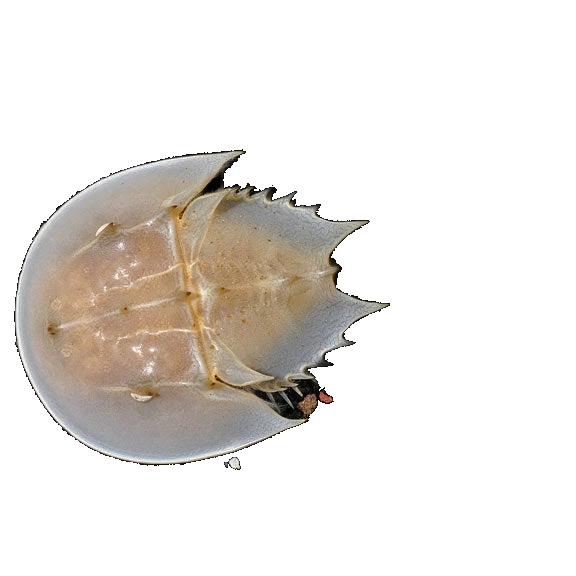
The Horseshoe Crab is greenish brown to light tan with a rounded dorsal body and a long tail spike, more closely related to spiders and mites than true crabs. When small, it is an efficient scavenger that aerates and maintains sand beds, but females can reach 12 inches in diameter and large individuals can harm worms, clams, and fish; supplement its diet with squid and shrimp pieces.
Quick facts
Handling caution: Long telson and sharp book-gill edges can pinch or scrape; handle by carapace edges, never by the tail
Identity
- Also known as
- American Horseshoe Crab; Atlantic Horseshoe Crab; King Crab
- Synonyms
- Xiphosura polyphemus
- Environment
- Saltwater
- Native to
- United States (Atlantic and Gulf coasts), Mexico (Gulf coast)
- Habitat
- Estuaries, sandy and muddy intertidal flats, and shallow coastal waters; adults burrow into soft substrate and move to deeper water in winter
- Sourcing
- Wild-caught
- Conservation
- Not Evaluated
Care
- Care level
- Moderate
- Temperament
- Peaceful
- Adult size
- 2 – 24 in (5.1 – 61 cm)
- Lifespan
- 15 – 20 yrs
- Min tank
- 180 gal (681 L)
- Growth rate
- Slow
- Placement
- Bottom
Water
- Temperature
- 68 – 77 °F (20 – 25 °C)
- pH
- 7.5 – 8.8
- Salinity
- 1.020 – 1.026 SG
- Flow
- Low-Moderate
Behavior & compatibility
- Social
- Solitary
- Aggression to own kind
- Low
- Active
- Night
- Reef safe
- With caution
- Invert safe
- With caution
- Shrimp safe
- With caution
- Clean-up role
- Detritus, Sand sifting, Leftover food
- Population boom risk
- Low
Feeding & breeding
- Diet
- Carnivore
- Foods
- Frozen, Live, Freeze-dried
- Breeding type
- Broadcast spawner
- Breeding difficulty
- Not bred in captivity
- Sexing
- Males are noticeably smaller than females and have modified clasper-like first walking legs used to grip the female during mating; females lack claspers and grow much larger
- Target feeding
- Beneficial
Something wrong or missing? Submit a correction
Care guide
Overview
Greenish-brown to tan coloring covers a rounded, helmet-shaped carapace trailing a long, rigid telson. As a juvenile it sifts sand for detritus and leftover food, but growth is slow and steady toward a large, long-lived bottom dweller that eventually outgrows most home systems and needs a deep sand bed plus mature water quality.
Care
A large, long-lived arthropod that needs a very spacious tank with a deep sand bed for burrowing and a stable, mature marine system to support its bioload. Juveniles are hardy and adaptable, but adults require far more space than most home aquariums can provide and are better suited to large systems or public aquaria. Good water quality is essential, since ammonia buildup and poor filtration are common causes of stress and death in captivity.
Feeding
Wild individuals feed on mollusks, worms, crustaceans, and organic detritus picked from the substrate. In captivity offer chopped squid, shrimp, clams, and pieces of fish, along with frozen meaty foods, dropped near the substrate where the crab can locate them with its walking legs. Small juveniles will also graze biofilm and leftover food scattered across the sand bed.
Tank mates
Small juveniles are generally peaceful scavengers that coexist with most reef inhabitants, but as they grow past a few inches they become capable of preying on worms, small clams, snails, and slow-moving fish. They should not be kept with delicate sessile invertebrates or small crustaceans once they reach a larger size. Their constant burrowing can also uproot corals or plants placed directly in the sand.
Breeding
Spawning occurs naturally on sandy beaches during spring and summer high tides tied to new and full moons, conditions essentially impossible to replicate in a home aquarium. Females bury clusters of eggs in the intertidal sand while males clasp onto their carapace to fertilize the eggs externally. Captive breeding is restricted to specialized research and aquaculture facilities using hatching jars and controlled water flow.
Health
Molting is the most vulnerable period, and soft-shelled individuals should be left undisturbed until the new exoskeleton hardens. Watch for signs of ammonia stress, gas supersaturation, or shell damage from sharp decor or aggressive tankmates. Old, non-molting adults naturally accumulate barnacles and dark pitting on the carapace, which is a normal sign of age rather than disease.
Sources
- FA254: Candidate Species for Florida Aquaculture: American Horseshoe Crab Limulus polyphemus
- Clinical Evaluation, Common Diseases, and Veterinary Care of the Horseshoe Crab, Limulus polyphemus
- Atlantic Horseshoe Crab | Online Learning Center | Aquarium of the Pacific
- SG190: The American Horseshoe Crab (Limulus polyphemus)
Something wrong or missing? Submit a correction
In the community
Popular tanks using Horseshoe Crab
No public tanks are showcasing Horseshoe Crab yet.