
Coral
ECC Twisted Metal Stylocoeniella
Stylocoeniella sp.AstrocoeniidaeEncrusting SPS corals
Add from My tanks →1 photos
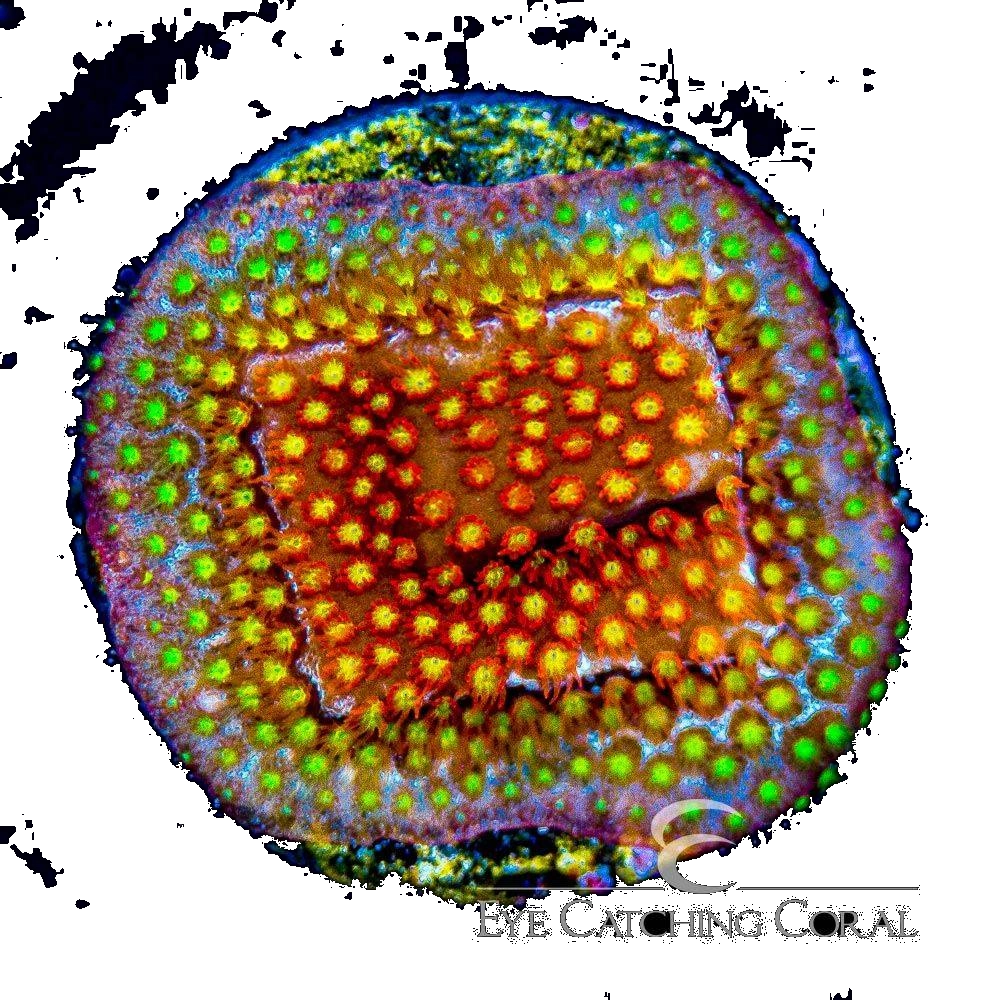
The ECC Twisted Metal Stylocoeniella is a bright encrusting SPS coral with red and yellow coloration and blue-green outer growth edges. It does well in low to medium light (75-250 PAR) with moderate flow on rockwork, is primarily photosynthetic, and grows at a moderate rate encrusting over surfaces.
Quick facts
Identity
- Also known as
- Twisted Metal Stylocoeniella; Encrusting SPS
- Environment
- Saltwater
- Native to
- Indo-Pacific
- Habitat
- Shallow reef flats and slopes, often in areas with variable light and moderate water movement
- Sourcing
- Aquacultured
- Conservation
- Not Evaluated
Care
- Care level
- Moderate
- Coral type
- SPS
- Temperament
- Peaceful
- Growth form
- Encrusting
- Adult size
- 0.8 – 12 in (1.9 – 30 cm)
- Spread
- 12 in (30 cm)
- Growth rate
- Moderate
- Placement
- Low, Middle
Water
- Temperature
- 76 – 79 °F (24 – 26 °C)
- pH
- 8.1 – 8.4
- dKH
- 8 – 9 dKH
- Salinity
- 1.024 – 1.026 SG
- PAR
- 75 – 250 PAR
- Flow
- Moderate
- Light
- Medium
Reef care
- Nutrient preference
- Low
- Alk/Ca uptake
- Medium
- Target feeding
- Beneficial
- Give it room
- 2 in (5.1 cm)
- Colors
- Red, Yellow, Blue, Green
Feeding & breeding
- Diet
- Photosynthetic
- Foods
- Coral food, Zooplankton, Phytoplankton
- Propagation
- Fragging
Something wrong or missing? Submit a correction
Care guide
Overview
Red and yellow patches spread across the colony surface, edged by bands of blue-green as new tissue encrusts outward. This Stylocoeniella grows as a low, moderate-paced mat across rockwork rather than branching upward, tolerating a wide PAR range and moderate flow. It suits reef keepers transitioning from LPS to SPS who can give it clearance from neighboring corals.
Care
Stylocoeniella is one of the more forgiving small polyp stony corals and is a reasonable starting point for hobbyists moving beyond softies and LPS into SPS keeping. It tolerates a fairly wide light range, generally doing well between 75 and 250 PAR, though acclimation should still be gradual when moving it to a brighter spot. Stable alkalinity, calcium, and magnesium are more important to its long-term health than hitting an exact PAR number, and mature systems with steady parameters produce the best coloration and growth.
Placement & acclimation
Mount frags on stable rockwork, glass, or a frag plug where the colony will have room to encrust outward without immediately contacting neighbors. Because it tolerates a broad light range, new specimens can be placed lower on the rockwork or under an overhang and should be acclimated gradually if moving toward a brighter position. Bare glass in a bare-bottom setup is also a workable placement since the coral does not require substrate.
Feeding
Most of this coral's energy comes from the zooxanthellae in its tissue, so supplemental feeding is not strictly necessary in a well-lit tank. Occasional target feeding with fine particulate foods, amino acids, or zooplankton can improve polyp extension and coloration, though the small polyps make heavy feeding impractical. A tank with reasonable nutrient levels tends to support better growth than an ultra-low nutrient system.
Neighbors
Give this coral generous clearance from neighbors since it encrusts quickly and will overgrow anything in its path, including other corals it directly contacts. It has no significant sweeper tentacles of its own, but sits low enough to be vulnerable to sweepers from Euphyllia, Galaxea, and other long-tentacled LPS placed above or beside it. Space of at least a couple of inches from other sessile invertebrates is advisable to avoid territorial contact.
Fragging
Frag by cutting or breaking off sections of the encrusting mat with a bandsaw, wire cutters, or chisel, then mounting the pieces on plugs or rubble. Cut edges typically heal and begin encrusting onto the new surface within a few weeks under stable conditions. Because growth is relatively fast for an SPS coral, colonies can be fragged repeatedly without major setbacks to the parent piece.
Pests & problems
Tissue recession or dieback typically appears where detritus has been allowed to settle on the encrusting mat, so flow should be sufficient to keep the surface clean. Pale or bleached patches usually point to a lighting change that was too abrupt or to nutrient levels dropping too low. Unlike some fast-growing Acropora and Montipora, this genus is not particularly prone to rapid tissue necrosis, making early problems easier to catch and correct.
Sources
Something wrong or missing? Submit a correction
In the community
Popular tanks using ECC Twisted Metal Stylocoeniella
No public tanks are showcasing ECC Twisted Metal Stylocoeniella yet.