
Coral
ECC Thunderstruck Psammocora
Psammocora sp.PsammocoridaeLPS/SPS encrusting corals
Add from My tanks →1 photos
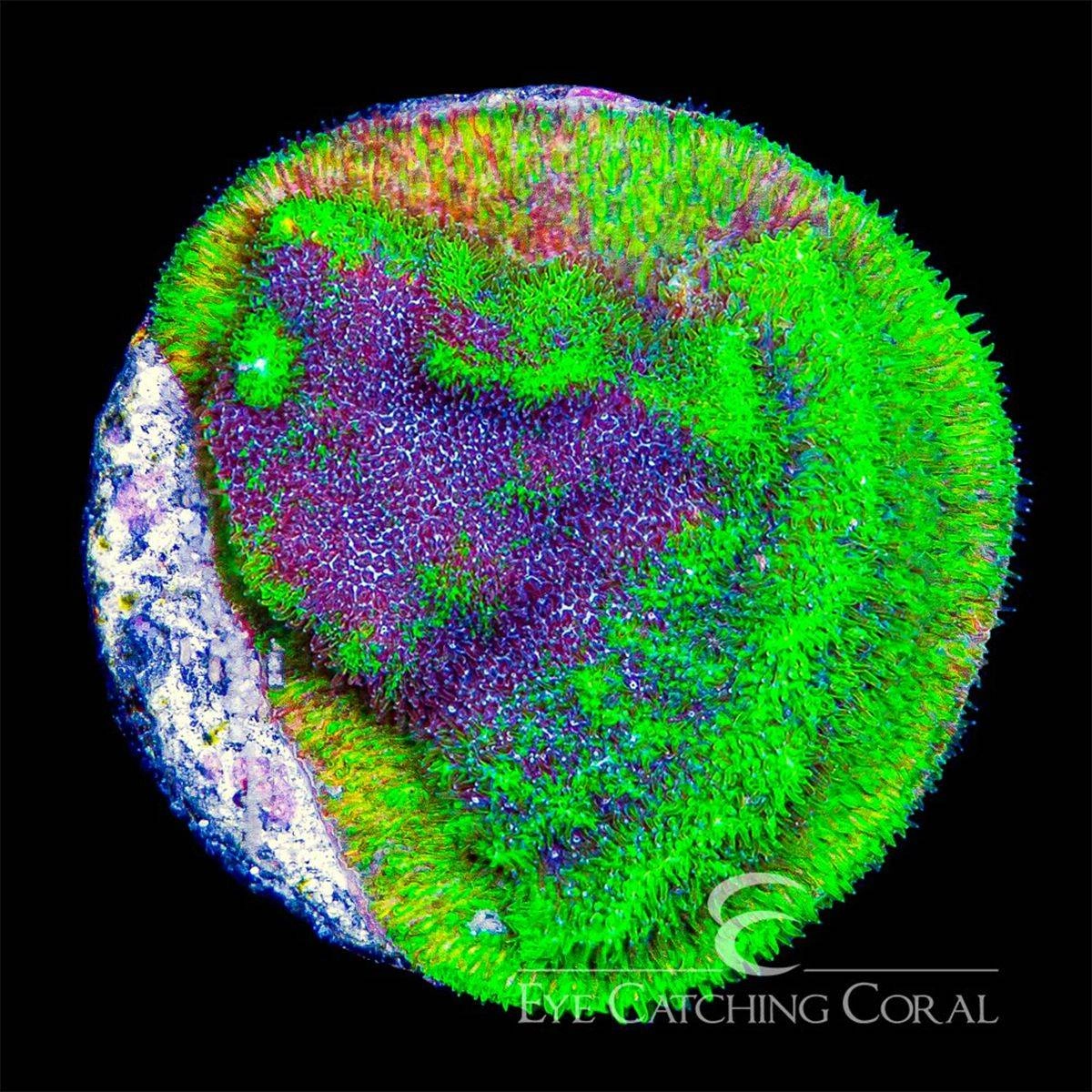
The ECC Thunderstruck Psammocora is a hardy, relatively fast-growing SPS coral with vivid green edges, a deep purple center, and a fuzzy polyp texture that gives it a bold, high-voltage appearance. It does best under medium light (150-250 PAR) and moderate flow, encrusting and spreading over rockwork to form a textured mat; like all encrusting corals it will fight corals it comes into direct contact with.
Quick facts
Identity
- Also known as
- Encrusting Psammocora; Sandpaper Coral
- Environment
- Saltwater
- Native to
- Indo-Pacific
- Habitat
- Shallow reef flats and lagoons with moderate to high water movement, encrusting rock and rubble substrates
- Sourcing
- Aquacultured
- Conservation
- Not Evaluated
Care
- Care level
- Moderate
- Coral type
- LPS
- Temperament
- Peaceful
- Growth form
- Encrusting
- Adult size
- 0.8 – 6 in (1.9 – 15 cm)
- Spread
- 12 in (30 cm)
- Growth rate
- Fast
- Placement
- Middle, High
Water
- Temperature
- 75 – 78 °F (24 – 26 °C)
- pH
- 8.1 – 8.4
- dKH
- 8 – 9 dKH
- Salinity
- 1.024 – 1.026 SG
- PAR
- 100 – 200 PAR
- Flow
- Moderate
- Light
- Medium
Reef care
- Nutrient preference
- Medium
- Alk/Ca uptake
- Medium
- Target feeding
- Beneficial
- Give it room
- 3 in (7.6 cm)
- Colors
- Green, Purple, Orange
Feeding & breeding
- Diet
- Photosynthetic
- Foods
- Coral food, Zooplankton, Phytoplankton
- Propagation
- Fragging
Something wrong or missing? Submit a correction
Care guide
Overview
Grows as a low, fuzzy-textured mat with deep purple centers fading to green edges, encrusting rock and rubble at a fast pace compared to most stony corals. It tolerates a range of light and flow once acclimated but will overgrow or clash with anything it contacts directly, so open space is essential. Best kept under medium light and moderate flow with gradual acclimation to avoid bleaching.
Care
Psammocora is one of the more forgiving stony corals available in the trade, tolerating a fairly wide range of light and flow once acclimated. It spreads by encrusting over rock and rubble, so give it open space since it will overgrow or fight neighboring corals it contacts directly. New colonies should be introduced under moderate light and flow first, then adjusted gradually since sudden changes in intensity can cause bleaching.
Placement & acclimation
Acclimate gradually to target light levels over one to two weeks to avoid bleaching, starting dimmer than the eventual placement. Mount frags on open rockwork with clearance on all sides so the colony has room to encrust outward without contacting other corals.
Feeding
Most of its nutrition comes from the photosynthetic algae housed in its tissue, so strong lighting alone will sustain a colony long term. Despite having small polyps, it responds well to supplemental feeding with amino acids and fine coral foods, which can improve growth rate and coloration. Broadcast or target feeding a few times a week is a reasonable supplement rather than a requirement.
Neighbors
Give this coral generous clearance from neighboring corals on the rockwork, since it lacks long sweeper tentacles but will still out-compete or be out-competed by anything it physically touches as it encrusts outward. It pairs well with other hardy SPS and LPS species kept under similar medium-light, moderate-flow conditions. Avoid placing faster growing branching corals directly above it, as shading can slow its spread.
Fragging
Colonies are fragged by cutting or snapping off encrusted sections of rock or by cutting through the skeleton with a coral saw or bone cutters, then securing the piece to a plug or rubble rock with glue or epoxy until it re-encrusts.
Pests & problems
Bleaching is the most common problem and is usually traced to light that is too intense or was increased too quickly after introduction to a new tank. Keep alkalinity and calcium stable since fluctuations can stress the calcareous skeleton and slow growth. Watch for pests such as flatworms or nudibranchs on the encrusting mat, which can be hard to spot given the coral's fine surface texture.
Sources
Varieties in the catalog
Something wrong or missing? Submit a correction
In the community
Popular tanks using ECC Thunderstruck Psammocora
No public tanks are showcasing ECC Thunderstruck Psammocora yet.