
Coral
ECC Red Xenia
Xenia sp.XeniidaeXenia corals
Add from My tanks →1 photos
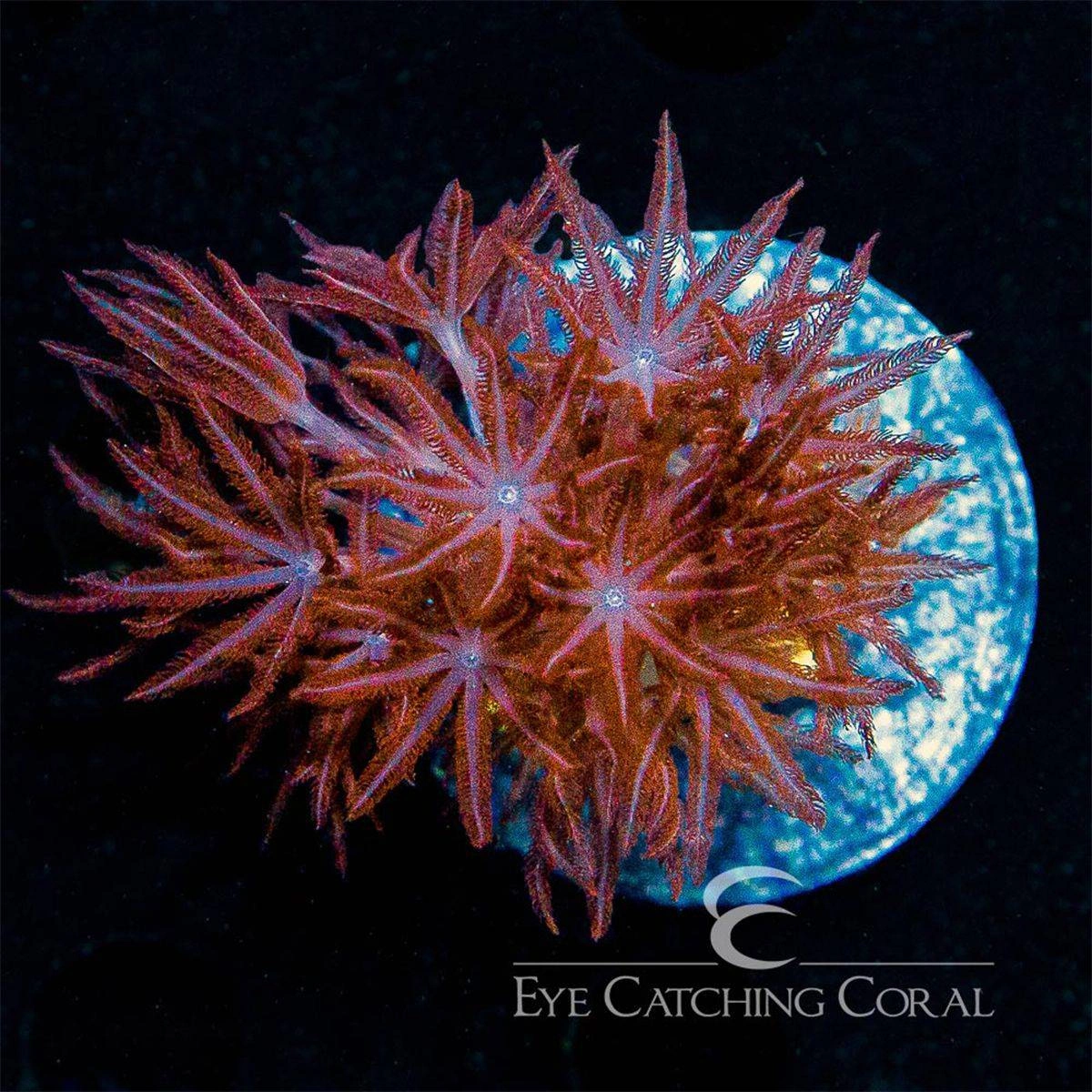
Red Xenia is a fast-growing soft coral known for its pulsing, waving polyps and vibrant red coloration. It thrives in moderate light (150-250 PAR) and low to moderate flow, filling open spaces or soft coral gardens; place it on isolated rockwork and prune regularly to keep it from spreading aggressively.
Quick facts
Identity
- Also known as
- Red Pulsing Xenia; Pulse Coral; Waving Hand Coral
- Synonyms
- Heteroxenia sp.; Xenia elongata
- Environment
- Saltwater
- Native to
- Indo-Pacific, Red Sea, Great Barrier Reef
- Habitat
- Shallow, high-light reef flats and lagoons with moderate to strong tidal currents, from near-surface down to about 30 meters
- Sourcing
- Both
- Conservation
- Not Evaluated
Care
- Care level
- Easy
- Coral type
- Soft
- Temperament
- Peaceful
- Growth form
- Colonial polyps
- Adult size
- 1 – 3 in (2.5 – 7.6 cm)
- Spread
- 12 in (30 cm)
- Growth rate
- Fast
- Placement
- Middle, High
Water
- Temperature
- 75 – 79 °F (24 – 26 °C)
- pH
- 8.1 – 8.4
- dKH
- 8 – 12 dKH
- Salinity
- 1.023 – 1.025 SG
- PAR
- 100 – 200 PAR
- Flow
- Low-Moderate
- Light
- Medium
Reef care
- Nutrient preference
- Medium
- Alk/Ca uptake
- Low
- Target feeding
- Beneficial
- Give it room
- 6 in (15 cm)
- Colors
- Pink, Brown, Cream, Purple
Feeding & breeding
- Diet
- Photosynthetic
- Foods
- Phytoplankton, Zooplankton, Coral food
- Propagation
- Fragging, Splitting
Something wrong or missing? Submit a correction
Care guide
Overview
Suits reef tanks with open sandbed rock islands or dedicated soft coral sections rather than crowded SPS displays, since colonies fill space fast. Red-toned polyps pulse continuously under 150-250 PAR and gentle flow, tolerating milder nutrient levels than most corals. Prune regularly and keep it isolated from slower neighbors to prevent overgrowth.
Care
Xenia is regarded as one of the easier soft corals for reef aquarists, tolerating a wide range of water conditions as long as light is adequate. Growth is fastest under low to moderate lighting and gentle to moderate flow, since excessive turbulence can keep the polyps from opening and pulsing normally. Because colonies spread over rock and glass quickly, many keepers mount frags on an isolated rock or plug well away from other sessile invertebrates to prevent overgrowth. It is one of the few corals that seems to do better with some dissolved nutrients in the water rather than ultra-clean SPS-grade conditions.
Placement & acclimation
Frags typically arrive attached to a small plug or piece of rubble that can be wedged into a crevice or set on an isolated rock island rather than the main reefscape, since Xenia spreads onto and over adjacent surfaces readily. Standard light acclimation is recommended, starting new colonies lower or shaded for the first one to two weeks before moving them up into their permanent higher-light spot. Positioning where flow and lighting are moderate helps the coral settle without excessive stress-induced mucus production.
Feeding
Xenia is almost entirely photosynthetic, relying on symbiotic zooxanthellae for the bulk of its energy needs, so intense feeding is not required. Occasional dosing of phytoplankton or other fine particulate coral foods can supplement growth, and the colony also absorbs dissolved organics and trace elements from the water column. Iodine and other trace element supplementation is often cited as helpful for sustaining the pulsing behavior over time.
Neighbors
Xenia lacks sweeper tentacles and potent chemical defenses compared to many other soft corals, making it broadly peaceful toward tankmates. It does produce mucus when stressed or handled, which can irritate neighboring soft corals if colonies are placed too close together. Given how readily it multiplies and can smother slower-growing neighbors, leaving generous open space or isolating it on its own rock is the safest approach.
Fragging
Xenia is among the easiest corals to propagate, often fragmenting itself naturally as pieces detach and drift onto nearby surfaces to form new colonies. Deliberate fragging can be done by cutting a stalk with a sharp blade and attaching the piece to a plug or rubble with cyanoacrylate gel, though pieces can also simply be pinched off. New frags typically attach and begin pulsing again within one to two weeks under stable conditions.
Pests & problems
Sudden cessation of pulsing is common and not necessarily a sign of illness, since the behavior is influenced by flow, lighting, and nutrient levels in ways that are not fully understood. Colonies can go through periods of receding or "melting back" for no obvious reason and then recover on their own. The biggest practical health issue for most keepers is unchecked spread rather than disease, since Xenia can overrun rockwork and equipment if not regularly pruned or contained.
Sources
Varieties in the catalog
Something wrong or missing? Submit a correction
In the community
Popular tanks using ECC Red Xenia
No public tanks are showcasing ECC Red Xenia yet.