
Coral
ECC Candy Corn Clove Polyp
Clavularia sp.ClavulariidaeClove polyps
Add from My tanks →1 photos
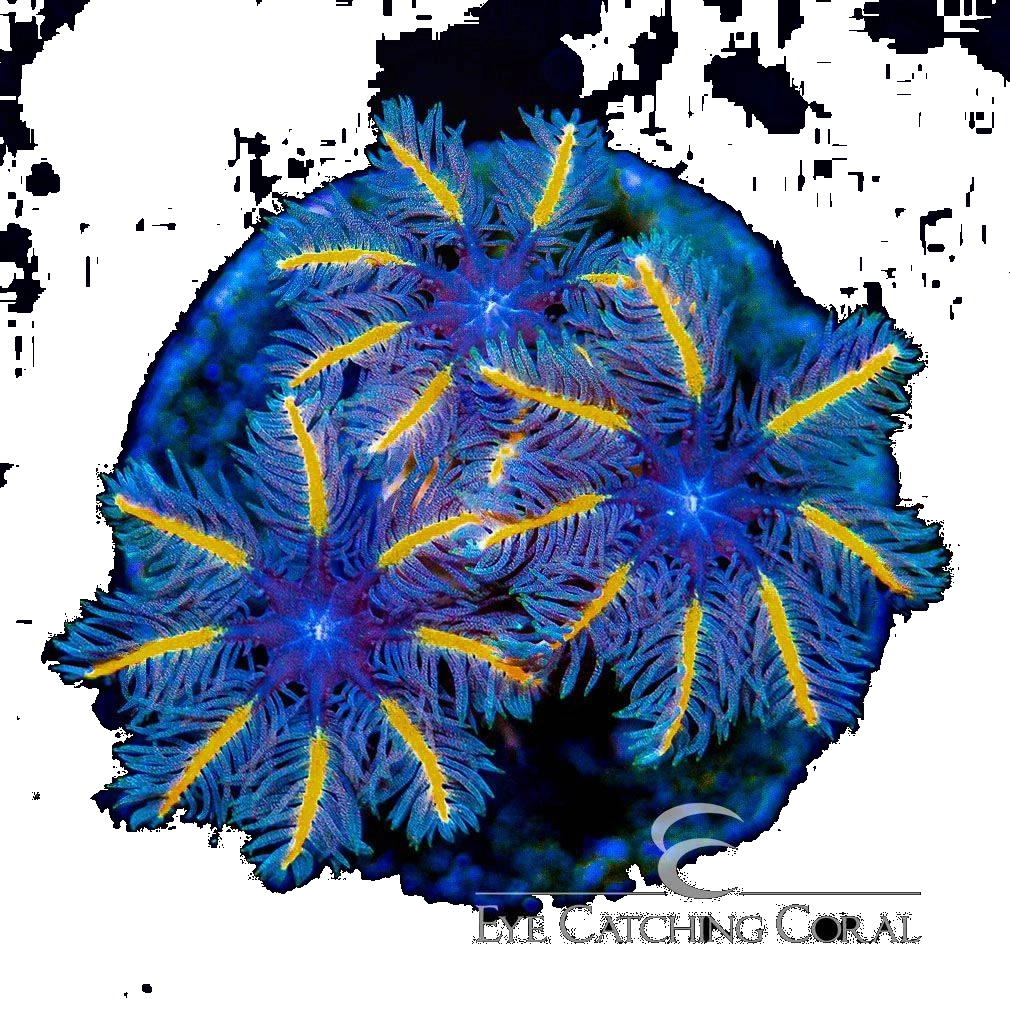
ECC Candy Corn Clove Polyps add bold color and movement with deep blue centers paired with bright orange striping that really stands out under blue reef lighting; they are easy to keep, grow quickly, and make a big visual impact fast, but give them space since they spread once settled. An easy soft coral for rockwork preferring low to medium lighting (75-250 PAR) and moderate, steady flow — place in mid-to-lower regions initially or on their own rock island to contain growth; primarily photosynthetic, though occasional broadcast feedings with phytoplankton, small coral foods, and amino acids enhance growth and coloration.
Quick facts
Identity
- Also known as
- Candy Corn Polyp
- Synonyms
- Clavulariidae sp.
- Environment
- Saltwater
- Native to
- Indonesia, Philippines, Fiji, Australia, Indo-Pacific
- Habitat
- Shallow to moderate-depth reef rubble, rock, and reef slopes with steady water movement and bright light
- Sourcing
- Aquacultured
- Conservation
- Not Evaluated
Care
- Care level
- Easy
- Coral type
- Soft
- Temperament
- Peaceful
- Growth form
- Colonial polyps
- Adult size
- 1 – 3 in (2.5 – 7.6 cm)
- Spread
- 12 in (30 cm)
- Growth rate
- Fast
- Placement
- Low, Middle
Water
- Temperature
- 75 – 81 °F (24 – 27 °C)
- pH
- 8.1 – 8.4
- dKH
- 8 – 11 dKH
- Salinity
- 1.024 – 1.026 SG
- PAR
- 50 – 150 PAR
- Flow
- Moderate
- Light
- Low
Reef care
- Nutrient preference
- Low
- Alk/Ca uptake
- Low
- Target feeding
- Beneficial
- Give it room
- 4 in (10 cm)
- Colors
- Blue, Orange
Feeding & breeding
- Diet
- Photosynthetic
- Foods
- Phytoplankton, Coral food, Zooplankton
- Propagation
- Fragging
Something wrong or missing? Submit a correction
Care guide
Overview
Suited to reef keepers who want fast, low-maintenance color on an isolated rock island rather than fused into main display work. This clove polyp variety shows deep blue centers ringed by bright orange striping, most pronounced under blue-heavy lighting. Colonial polyps spread readily via stolons, so containment and spacing from slower corals matter more than water chemistry precision.
Care
This soft coral spreads by stolons that creep across rock, so it is best kept on its own frag plug or isolated rock island surrounded by sand rather than fused into main display rockwork. It tolerates a wide light range but colors up best under moderate PAR with strong blue spectrum, and it prefers steady, moderate flow that lets the polyps sway without closing. Because it lacks a calcium carbonate skeleton, it is forgiving of minor swings in calcium and alkalinity compared to LPS or SPS corals.
Placement & acclimation
Mount frags on a small dedicated rock or plug set apart from the main rockwork, since the stolons cannot cross bare sand and this creates a natural containment barrier. Acclimate gradually to tank lighting over one to two weeks if moving from lower-light conditions, watching for polyp retraction as a sign of stress. Wait for full attachment before adjusting placement, as newly mounted frags detach easily from flow.
Feeding
Most of its energy comes from the zooxanthellae housed in its tissue, so supplemental feeding is optional rather than essential. Occasional broadcast feeding of phytoplankton, fine zooplankton, or powdered coral foods can improve growth rate and polyp coloration over time. Avoid overfeeding, since excess nutrients in the water column can dull the bright pigmentation this coral is prized for.
Neighbors
It carries no sweeper tentacles and poses no direct sting threat to neighboring corals, but its rapid mat-forming growth can smother slower-growing LPS such as acans and favias if given the chance. Keep a buffer of bare rock or sand between colonies and any coral that cannot compete for space. It is generally safe alongside fish, shrimp, and other reef invertebrates.
Fragging
Propagate by cutting sections of stolon mat with a sharp blade or scalpel along with a piece of the rock or plug they are attached to. New colonies will continue producing polyps along the runners once settled, and unwanted spread can be trimmed back the same way. Frags typically recover and begin extending polyps within one to two weeks.
Pests & problems
Sudden tissue loss or a receding stolon mat is often linked to bacterial stress, detritus buildup, or pest activity rather than water chemistry alone. Inspect the mat at night for nudibranchs or sundial snails, which can strip polyps quickly if left unchecked. Improving random flow to keep debris off the stolon mat and running fresh carbon can help halt a decline before it spreads.
Sources
Something wrong or missing? Submit a correction
In the community
Popular tanks using ECC Candy Corn Clove Polyp
No public tanks are showcasing ECC Candy Corn Clove Polyp yet.