
Marine Fish
Dwarf/Zebra Lionfish
Dendrochirus zebraScorpaenidaeLionfish
Price: $45.12 USD
Add from My tanks →1 photos
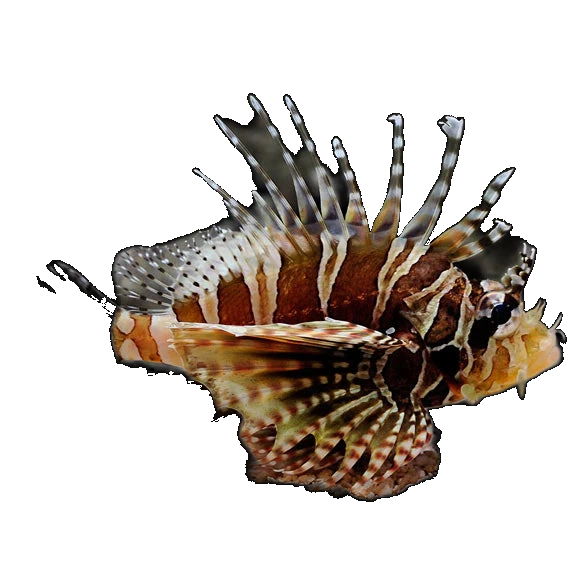
The Dwarf/Zebra Lionfish (Dendrochirus zebra) is a predatory marine fish known for bold red, white, and black vertical striping and elegant fan-shaped pectoral fins, with venomous dorsal spines that require careful handling. It needs a minimum 190-liter tank with rockwork hiding places, moderate care, and a carnivorous diet, and is reef-compatible only with caution since it preys on small fish, shrimp, and crabs.
Quick facts
Handling caution: Venomous dorsal, pelvic, and anal spines causing a painful sting similar to a bee sting; treat with hot water and seek medical care.
Identity
- Also known as
- Zebra Turkeyfish; Dwarf Lionfish
- Synonyms
- Pterois zebra
- Environment
- Saltwater
- Native to
- Red Sea, East Africa, Indian Ocean, Western Pacific, Japan, Australia
- Habitat
- Coral, rubble, and rock bottoms of reef flats, sheltered lagoons, and coastal to outer reef areas, usually 3-60 m depth, occasionally to 80 m or more.
- Sourcing
- Wild-caught
- Conservation
- Not Evaluated
Care
- Care level
- Moderate
- Temperament
- Semi-Aggressive
- Adult size
- 2 – 9.8 in (5.1 – 25 cm)
- Lifespan
- 5 – 10 yrs
- Min tank
- 55 gal (208 L)
- Growth rate
- Moderate
- Placement
- Middle
Water
- Temperature
- 72 – 78 °F (22 – 26 °C)
- pH
- 8.1 – 8.4
- dKH
- 8 – 12 dKH
- Salinity
- 1.020 – 1.025 SG
- Flow
- Low-Moderate
Behavior & compatibility
- Social
- Solitary
- Aggression to own kind
- Moderate
- Active
- Night
- Reef safe
- With caution
- Plant safe
- Yes
- Shrimp safe
- No
Feeding & breeding
- Diet
- Carnivore
- Foods
- Frozen, Live, Freeze-dried
- Breeding type
- Broadcast spawner
- Breeding difficulty
- Difficult
- Sexing
- Not reliably distinguishable externally outside of courtship, when females become smaller with an almost white face; males are more aggressive during spawning.
Something wrong or missing? Submit a correction
Care guide
Overview
Suits keepers with a dedicated predator setup rather than a mixed reef of small fish and shrimp. Bold red, white, and black banding covers the body and broad, fan-like pectoral fins, aiding camouflage among rockwork. Nocturnal and slow-moving, it hides by day and hunts after dark, delivering a venomous sting if mishandled.
Care
A slow, deliberate ambush predator that spends much of the day tucked under ledges or overhangs, becoming more active as light fades. It tolerates a wide range of reef parameters but benefits from dim to moderate lighting and plenty of rockwork with caves to reduce stress. Because it is not a strong swimmer, tankmates that outcompete it for food should be avoided, and water changes should be consistent since it produces a fair bioload from a meaty diet.
Feeding
New arrivals are often started on live saltwater feeder shrimp or small live fish before being weaned onto frozen silversides, krill, or shrimp offered on tongs or tweezers. Feeding two to three times weekly is usually sufficient once the fish is established and feeding reliably. Whole prey items retain more nutritional value than pre-cut pieces, and frozen food should be thawed in tank water rather than at room temperature.
Tank mates
Any fish, shrimp, or crab small enough to fit in its mouth is at risk, including gobies, small wrasses, and ornamental shrimp, so tankmates should be chosen from species too large to be swallowed. It generally ignores corals and sessile invertebrates, making it reef safe with caution rather than reef safe outright. Multiple individuals can sometimes be kept together and have even been observed cooperating during hunts, but this is not guaranteed in captivity and aggression can occur if food is scarce.
Breeding
Pairs spawn at night after a brief rapid ascent together, releasing a buoyant gelatinous egg mass containing thousands of eggs that hatch within about a day and a half. This has occurred in home aquariums on occasion, but raising the pelagic larvae past settlement is difficult and rarely attempted outside of specialized facilities. Sexual differences are subtle and mostly apparent only during courtship, complicating deliberate pairing.
Health
Generally hardy once feeding, but sensitive to copper-based medications, so alternative treatments should be used if disease control is needed. Stress from harsh lighting or lack of hiding spots can suppress appetite, particularly in newly introduced specimens. Careful acclimation and quarantine reduce the risk of injury from handling given the venomous spines.
Sources
Something wrong or missing? Submit a correction
In the community
Popular tanks using Dwarf/Zebra Lionfish
No public tanks are showcasing Dwarf/Zebra Lionfish yet.