
Marine Invertebrates
Clown Mantis Shrimp
Odontodactylus scyllarusOdontodactylidaeMantis shrimp
Price: $49.35 USD
Add from My tanks →1 photos
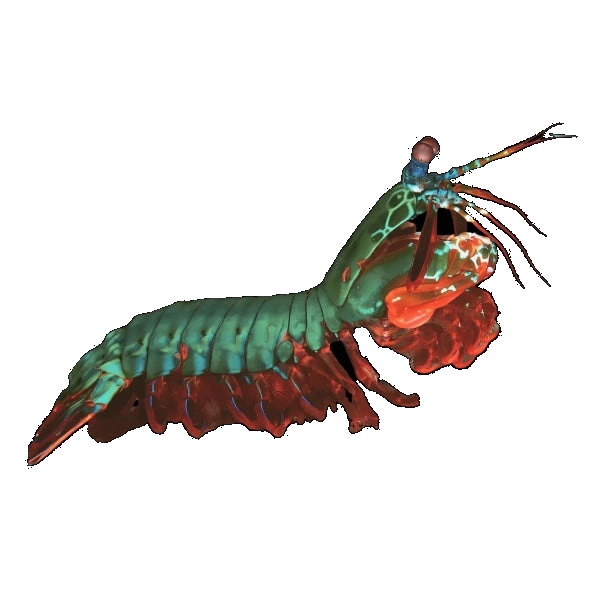
The Clown Mantis Shrimp, also called the Peacock Mantis Shrimp, belongs to the Smashing group with large colorful blue- or green-rimmed eyes and a green body with red shell outlines. It is extremely aggressive and must be housed alone in a species aquarium with a sandy bottom, rubble, and live rock for a cave — never with fish or other invertebrates; its raptorial claws smash crustacean and crab shells, so feed live feeder fish, crabs, and frozen meaty foods like fish, scallop, and shrimp.
Quick facts
Handling caution: Powerful raptorial smashing claw can break skin, crush fingers, or shatter aquarium glass; not venomous
Identity
- Also known as
- Peacock Mantis Shrimp; Harlequin Mantis Shrimp
- Synonyms
- Odontodactylus scyllarus (Linnaeus, 1758)
- Environment
- Saltwater
- Native to
- Indo-Pacific, East Africa, Red Sea, Indonesia, Philippines, Australia, Guam, Japan
- Habitat
- Sandy, muddy, and rubble zones of coral reef slopes, building U-shaped burrows in compacted sand or rubble at depths of roughly 3-40 meters
- Sourcing
- Wild-caught
- Conservation
- Not Evaluated
Care
- Care level
- Expert Only
- Temperament
- Aggressive
- Adult size
- 3 – 7 in (7.6 – 18 cm)
- Lifespan
- 3 – 6 yrs
- Min tank
- 40 gal (151 L)
- Growth rate
- Moderate
- Placement
- Bottom
Water
- Temperature
- 72 – 78 °F (22 – 26 °C)
- pH
- 8.1 – 8.4
- dKH
- 8 – 12 dKH
- Salinity
- 1.023 – 1.025 SG
- Flow
- Low-Moderate
Behavior & compatibility
- Social
- Solitary
- Aggression to own kind
- High
- Active
- Daytime
- Reef safe
- No
- Invert safe
- No
- Shrimp safe
- No
- Clean-up role
- Pest control
- Population boom risk
- Low
Feeding & breeding
- Diet
- Carnivore
- Foods
- Frozen, Live, Freeze-dried
- Breeding type
- Broadcast spawner
- Breeding difficulty
- Not bred in captivity
- Sexing
- Not reliably distinguished externally; females may appear slightly larger and are noted by egg mass carriage when gravid
- Target feeding
- Beneficial
Something wrong or missing? Submit a correction
Care guide
Overview
Wild-caught throughout the Indo-Pacific, this stomatopod shows a green body outlined in red shell segments with large blue- or green-rimmed eyes. A solitary burrower, it demands a species-only tank with deep sand, rubble, and stable rock for its home. Its smashing claws crush hard-shelled prey and can crack thin glass, so expert keepers only.
Care
This is a solitary, territorial stomatopod that must be kept alone in a species-only tank, never with fish, crustaceans, or other invertebrates, all of which it will hunt and kill. Provide a deep sand bed mixed with coral rubble so it can build or occupy a burrow, along with sturdy live rock arranged so it cannot collapse. A tightly fitted lid is essential since this animal is a capable escape artist, and thick glass or acrylic is strongly recommended because its strike can crack standard aquarium panes.
Feeding
Feed a varied carnivorous diet of hard-shelled prey such as snails, crabs, clams, and unshelled shrimp, along with occasional whole fish, to keep the smashing club conditioned and the animal properly nourished. Live feeder crabs or snails offered periodically encourage natural hunting behavior, while frozen and freeze-dried meaty foods can supplement the diet between live feedings. Enrichment with vitamin or omega-3 soaked foods helps prevent malnutrition, which is a common issue in long-term captive specimens.
Tank mates
No tankmates of any kind are advisable; this species will smash and consume fish, crabs, shrimp, and snails introduced to its aquarium, and even hard corals or clam shells can be damaged by stray strikes. Only very large, fast fish might occasionally coexist briefly, but this is risky and not recommended for a stable long-term setup. A dedicated species tank is the only reliable option for keeping this animal safely.
Breeding
Captive breeding is rarely attempted and considered very difficult, since introducing a male and female risks lethal aggression if the female is not receptive. Gravid females carry a visible mass of eggs and require a large tank with separate territories and careful monitoring during any pairing attempt. Successful rearing of larvae in home aquaria has not been well documented in the hobby.
Health
Malnutrition is a recurring problem in captivity if the diet lacks variety or enrichment, so rotating hard-shelled prey with vitamin-enriched foods helps maintain long-term health. Molting is a vulnerable period during which the animal should not be disturbed and extra hiding space should be available. Copper-based medications are highly toxic to this species and must never be used in its aquarium.
Sources
Something wrong or missing? Submit a correction
In the community
Popular tanks using Clown Mantis Shrimp
No public tanks are showcasing Clown Mantis Shrimp yet.