
Freshwater Fish
Assorted African Cichlids
CichlidaeMbuna Cichlids
Add from My tanks →1 photos
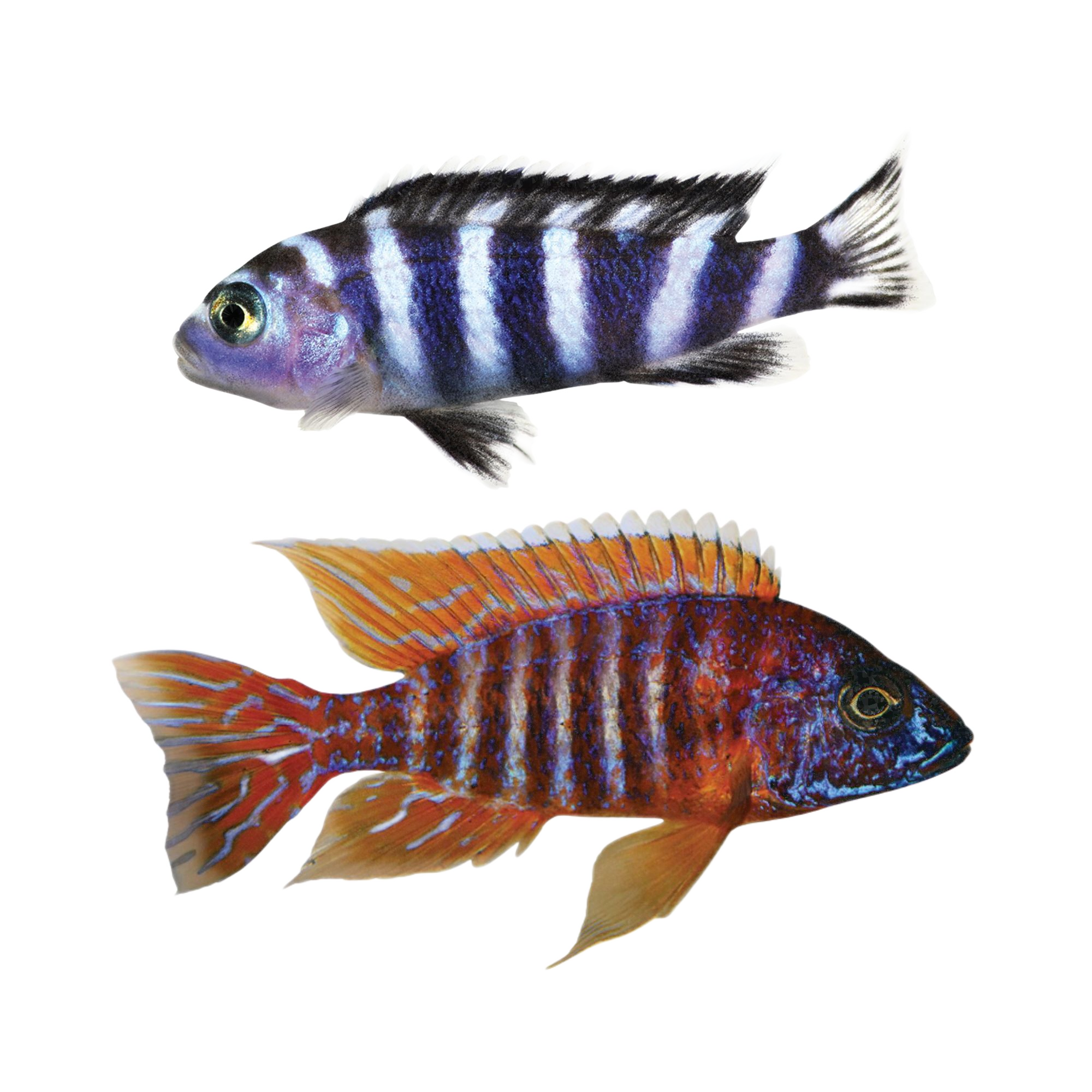
Assorted African cichlids, typically Lake Malawi rock-dwellers (mbuna); brightly colored and active but territorial, needing hard alkaline water and plenty of rockwork.
Quick facts
Identity
- Also known as
- African cichlids; Malawi cichlids; rock-dwelling cichlids; mbuna mix
- Synonyms
- Maylandia; various former Pseudotropheus spp.
- Environment
- Freshwater
- Native to
- Lake Malawi (Malawi, Mozambique, Tanzania)
- Habitat
- Rocky shorelines and shallow rock piles of Lake Malawi, where fish graze on algae-covered rock surfaces (aufwuchs) and shelter in crevices.
- Sourcing
- Captive-bred
- Conservation
- Not Evaluated
Care
- Care level
- Easy
- Temperament
- Aggressive
- Adult size
- 1 – 5 in (2.5 – 13 cm)
- Lifespan
- 5 – 8 yrs
- Min tank
- 55 gal (208 L)
- Growth rate
- Fast
- Placement
- Rock & glass
Water
- Temperature
- 75 – 82 °F (24 – 28 °C)
- pH
- 7.8 – 8.6
- GH
- 10 – 20 dGH
- dKH
- 10 – 15 dKH
- Flow
- Moderate
Behavior & compatibility
- Social
- Harem · groups of 6+
- Aggression to own kind
- High
- Active
- Daytime
- Plant safe
- No
- Shrimp safe
- No
Feeding & breeding
- Diet
- Omnivore
- Foods
- Flakes, Pellets, Algae, Frozen, Vegetables, Freeze-dried
- Breeding type
- Mouthbrooder
- Breeding difficulty
- Easy
- Sexing
- Many mbuna show sexual dichromatism as adults, with dominant males more intensely colored than females; some species (e.g., yellow labs) require vent examination or egg-spot counts on the anal fin to confirm sex reliably.
Something wrong or missing? Submit a correction
Care guide
Overview
Adults typically reach two to five inches depending on species, forming a mixed grouping of Lake Malawi rock-dwellers rather than a single type. Colors and patterns vary widely across the assortment, from barred to solid hues, with males usually the more colorful sex. Best suited to a heavily rockscaped tank stocked densely enough to spread out constant territorial disputes.
Care
Mbuna are hardy fish that adapt well to captivity provided the water stays hard and alkaline, mimicking the mineral-rich conditions of Lake Malawi. A tank dominated by rockwork arranged into caves, ledges, and sightline breaks is essential, since territorial disputes are constant and hiding spots reduce casualties. Overstocking is actually a common strategy with this group, since a crowded tank with many territories spreads out aggression rather than letting one or two fish dominate.
Feeding
In the wild these fish graze almost constantly on algae and biofilm coating the rocks, so captive diets should lean vegetable-heavy with spirulina-based flakes or pellets as a staple. Occasional meaty foods like brine shrimp or bloodworms can be offered as a treat but should not dominate the diet, since excess protein has been linked to bloat and other digestive issues in mbuna. Feeding small amounts several times a day better matches their natural grazing behavior than one or two large meals.
Tank mates
Mbuna are best kept as a species-only or mixed-mbuna community rather than paired with softwater community fish, since their water chemistry needs and aggression levels clash with most other freshwater groups. Stocking many individuals and species together at once, ideally in groups with more females than males, helps disperse territorial aggression across the tank. Avoid mixing mbuna with the larger, more predatory hap and peacock cichlids unless tank size and stocking density are carefully managed, as size and temperament mismatches can lead to bullying or predation.
Breeding
Mbuna are maternal mouthbrooders: after spawning on a flat rock, the female collects the fertilized eggs into her mouth and incubates them for roughly three weeks before releasing free-swimming fry. Males are polygamous and will court and spawn with multiple females in rotation, so a ratio of at least three females per male helps prevent any one female from being over-harassed. Fry can be raised on crushed flake or newly hatched brine shrimp once released, and holding females can be moved to a separate tank to protect the brood.
Health
Malawi bloat is a well-known ailment in this group, often triggered by excess protein in the diet or poor water quality, and can be fatal if untreated. Stable, well-buffered water with regular partial water changes helps prevent stress-related disease outbreaks, since these fish are sensitive to swings in pH and hardness despite their reputation for hardiness. Aggression-related injuries such as torn fins and lip damage are also common in undersized or understocked tanks.
Sources
Something wrong or missing? Submit a correction
In the community
Popular tanks using Assorted African Cichlids
No public tanks are showcasing Assorted African Cichlids yet.